Wednesday, 7 November 2018

TRE Talk Radio Europe 'gadget guru' tech for November 2018

Here's the technology I talked about in my November 2018 TRE Talk Radio Europe 'gadget guru' conversation:

Palm smartphone

Remember Palm organisers? Well, the Palm name is back – and this time it’s on a tiny smartphone that saves you from taking your regular smartphone out of your pocket or bag. It weighs 62½ grams, it’s 50mm wide by 97mm tall and it’s 7.4mm thick. On the front is a 3.3-inch touchscreen and inside is a Qualcomm Snapdragon processor running the Android operating system. The front and back are made from Gorilla Glass 3 and the phone is rated for IP68 water and dust protection. It even finds room for a 12 megapixel camera on the back and an 8 megapixel camera on the front.

What’s the point? Well, I suppose it’s a bit like having a smartwatch on your wrist – except this is potentially smarter but not quite so convenient. This 'companion phone' connects to your regular mobile number, so you can leave your big expensive phone at home and just take the little one.

There are two bits of bad news for Palm fans. Firstly, there’s not really any connection with the old company except the name. And the new Palm phone is currently only available from the Verizon network in the United States. So even if you spend $349.99 to get hold of one, you’ll need another phone on a Verizon contract to make it work.

Facebook Portal video screen

Facebook Portal is a smart display screen that offers hands-free video calling. There’s a choice of two devices: one has a 10.1-inch screen and one has a 15.6-inch screen (the bigger one is called the Portal+; it’s better quality and can also be adjusted more, but other than that they’re pretty similar). Both have Amazon's Alexa voice-controlled personal assistant service built in. They also have Facebook Messenger and a 12-megapixel camera, which means you can chat via video, with facial recognition enabling it to automatically zoom in on your face as you move about. So if your friends have got Facebook Messenger on their smartphone or their tablet, you can ask your Facebook Portal to call them. And because it runs on Amazon Alexa, you can also ask for sports results, weather forecasts, listen to music, do your shopping or control smart home devices. It can even be a picture frame when you’re not using it.

At the moment both devices are only available for pre-order in the United States, with the regular Portal costing $199.

Google Home Hub

Facebook has its Portal, Amazon has its Echo Show, now Google has its Home Hub. This is another voice and touch controlled information centre for your house. However, unlike the Portal, there’s no camera – so you might feel happier about having it in the bedroom.
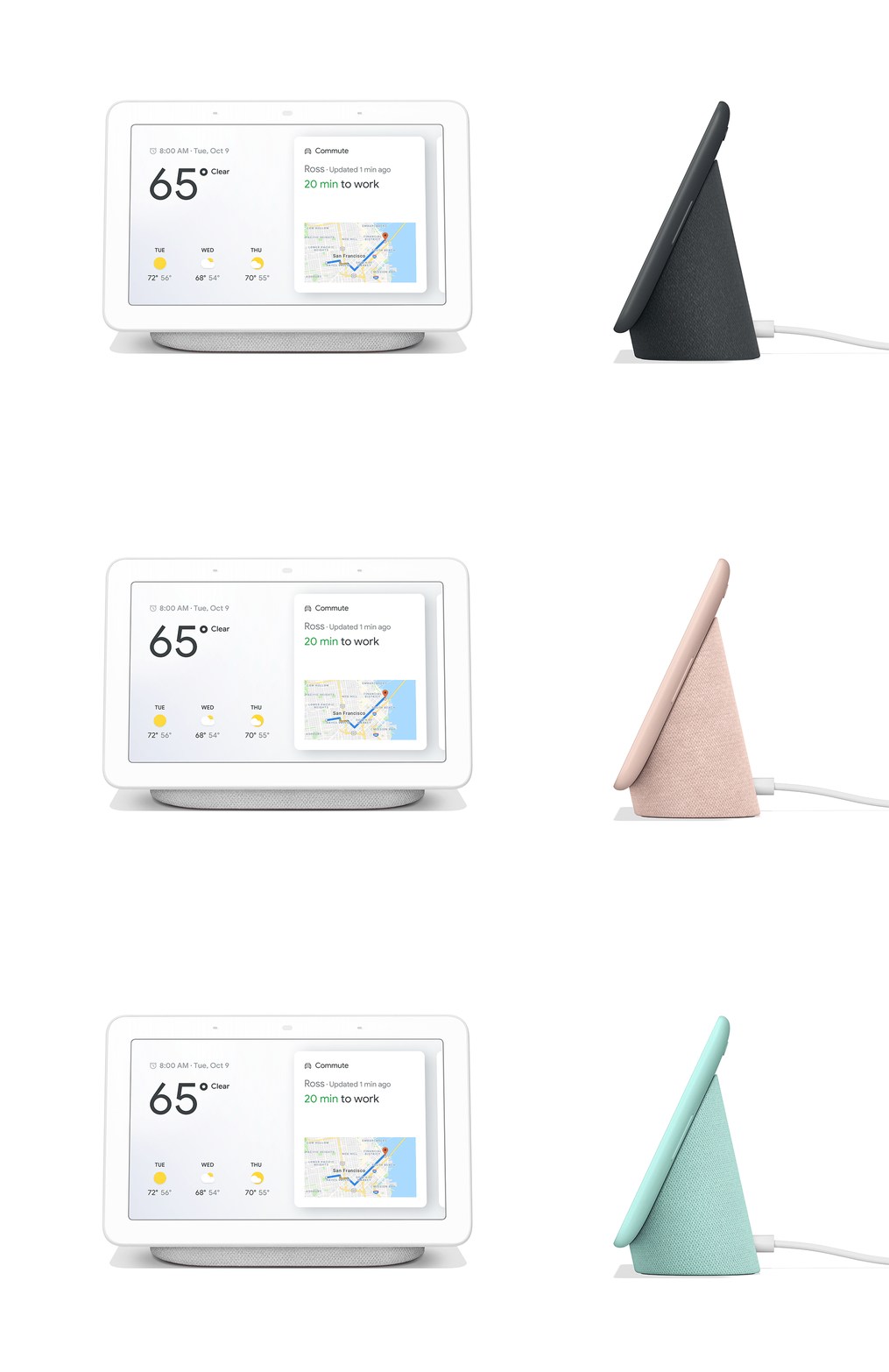
Google already has voice-controlled assistants but this adds a 7-inch screen, so you can ask it for maps, for videos, for photos, for music, for recipes, you can look at your calendar, and so on. Plus it’ll connect with compatible smart home devices to dim your lights, adjust the thermostat or watch security cameras.

Google’s Home Hub is currently only available in the UK (£139), the USA and Australia.

iBubble underwater drone

This is described as “the world’s first intelligent autonomous and fully wireless underwater drone”. It’s from a French company called Notilo Plus, which specialises in underwater exploration, and essentially it’s a remote-control submarine that can drive itself.

You fit your camera inside, strap on your special wristband and the iBubble will follow you underwater for up to an hour and down to 60 metres - almost 200 feet - without bumping into things. You can tell it to follow you, to go ahead of you, to film from the side, to circle around you, to come to you or to stay still. It can also be connected to an optional cable and directly controlled from the surface using an app on your phone or tablet.

The retail price of the iBubble is $4,099 (around €3,600), excluding VAT and the cost of a camera. It’s designed to work with newer models of GoPro and other action cameras that use the same type of mount.

Monday, 29 October 2018

Rocket FM Lewes: 'Talking Culture' 29th October 2018

The music on my Rocket FM Lewes 'Talking Culture' show this afternoon included:

Pentatonix: Can't Sleep Love
Harriet: Afterglow
Rufus Wainwright: Across The Universe
Johnny Cash: Hurt
Mary Gauthier: I Drink
Ward Thomas: Guilty Flowers
Show of Hands: Walk With Me
Ellie Goulding: How Long Will I Love You
Justin Hayward: The Best Is Yet To Come
Norrie Paramor and the BBC Midland Radio Orchestra: Thank You For The Music

Sunday, 28 October 2018

Be a person instead of a source of fragments

In his blog post You don’t have to live in public, Austin Kleon points us towards Jaron Lanier's book You Are Not A Gadget. He quotes Jaron's list of things "you can do to be a person instead of a source of fragments to be exploited by others", which are often counter-intuitive for the online services we use. Spend time crafting our work, don't force it into social media templates, express yourself...

However, it's Jaron's introductory phrase - be a person instead of a source of fragments to be exploited by others - that particularly resonates with me. Perhaps it's because I hear parallels with "if you're not paying for the service, you're the product, not the customer". But probably because I don't do it enough.

Monday, 22 October 2018

Rocket FM Lewes: 'Talking Culture' 22nd October 2018

The music on today's Rocket FM Lewes 'Talking Culture' show included:

Beth Nielsen Chapman: Almost Home
Jamie Cullum: I Could Have Danced All Night
Julie Andrews: Just You Wait
Frank Sinatra: Get Me To The Church On Time
Beyonce: Love On Top
BBC Midland Radio Orchestra: Go West
Garth Hewitt: Oscar Romero
Was (Not Was): Walk The Dinosaur
Amy Winehouse: Tears Dry On Their Own
Celine Dion: Here There And Everywhere
Feist: Mushaboom
Britney Spears: Everytime
Barbra Streisand: Taking A Chance On Love

Monday, 15 October 2018

Rocket FM Lewes: 'Talking Culture' 15th October 2018

I'm presenting 'Talking Culture' on Rocket FM Lewes for the next three weeks. My guests in this week's show were:
Simone Riley, the current chair of Chalk Gallery,
Lulah Ellender, who wrote Elizabeth's Lists,
Vivienne Lynn, whose art is currently on show at Martyrs Gallery.

Today's music included...
Simon and Garfunkel: Keep The Customer Satisfied
The Partridge Family: I Think I Love You
Nickel Creek: Ode to a Butterfly
Norrie Paramour and the BBC Midland Radio Orchestra: Copacabana
Eddi Reader: Patience of Angels
Marc Cohn: Walk Through The World
The Chefs: 24 Hours
Charlie Dore: Here Comes The Sun
Renaissance: Northern Lights
Bellowhead: Betsy Baker
Kathy Mattea: Where've You Been
Josh Groban: Granted

Tuesday, 25 September 2018

My TRE Talk Radio Europe technology for September 2018

Here's a summary of the tech I mentioned in this afternoon's 'gadget guru' chat on TRE Talk Radio Europe:

Apple Watch 4

This month Apple has announced three new iPhones - the iPhone XS, the iPhone XS Max and the iPhone XR - as well as a new Apple Watch. The smartwatch is particularly notable because it includes a couple of impressive features.

Probably the most significant update from previous models is that the Series 4 Apple Watch can act as an electrocardiogram (ECG). There are electrodes built into the front and there’s a heart rate sensor in the back. If you’re concerned about heart health, these readings could help you - and help your doctor, too.

The other major new feature is a fall detector: if you fall over, the watch can sense this and call for help.

There''s a choice of two sizes and various specifications: pricing starts from £399 / €429.

Vivosmart 4 fitness wristband

The new Garmin Vivosmart 4 is – as the name suggests – the fourth generation of this particular fitness-focussed smart wristband. What’s so special? It includes a pulse oximeter, which can keep track of your blood oxygen level. This helps with tracking your sleep; not just the amount but the quality as well.

It also includes a heart rate monitor that links with your stress level and your sleep quality to work out the best time for you to start a workout.

Pricing is around £120 (€135).

Segway Drift W1 electronic skates

Remember the Segway, which was an incredibly clever two-wheeled platform that you could stand on and ride? There was just one problem: in the UK (and an assortment of other countries) you couldn’t ride it on the road – and you couldn’t ride it on the pavement either.

Since the launch of the Segway PT in 2001, the company has changed ownership a couple of times – but it's not gone away.

And so we're introduced to the Segway Drift W1. These, according to the company, are self-balancing e-Skates. In reality, they have the appearance of a motorised roller skate crossed with platform shoes. Pricing is £359 (just over €400), with delivery expected next month.

When you stand on the skates, you'll find they balance themselves, so all you need to do is lean forwards to go and lean sideways to steer. Your maximum speed is 7½ mph (12km/h), which is two or three times faster than walking, and your rechargeable batteries will keep you moving for up to 45 minutes.


Just one bit of bad news. Unfortunately, it’s not just the technology that’s similar to the original – it’s also the legal situation. Here in the UK, usage is restricted to private property – with the owner’s permission, of course.

Locky smart key

Gnerally speaking, smart locks have one big disadvantage: you need to change the lock in your door. But what if you could keep your lock and turn your key into a smart key? That’s exactly what this particular Kickstarter project is all about.

Locky is a little device that clips onto your key, like a fancy key cover. Inside that fancy cover is a tiny battery that lasts for around a year, some clever sensors and a Bluetooth connection.

Basically, the sensors work out if you’ve turned your key in the lock. The Bluetooth connection then links with an application on your phone to warn you if you’ve left home without locking the house. It’s also capable of warning you if you’ve left your key behind and can even help you find the key if you put it down somewhere. Plus it keeps a record of key use, so if all your family have a Locky on their key, you know if someone’s in and when they returned.

Most importantly, it’s still a mechanical key. It can’t be hacked and it unlocks your door even if the battery goes flat.

The company reckons they’ll start shipping these in March next year for around £60 each but there are currently special offers if you commit early.

Tuesday, 21 August 2018

TRE Talk Radio Europe 'gadget guru' technology for August 2018

Here is a quick reminder of the technology I mentioned in today's conversation with Dave Hodgson on TRE Talk Radio Europe:

Samsung Galaxy Note9

Is it a giant phone or a small tablet? Either way, the newest member of the Samsung Galaxy Note dynasty looks pretty similar to its predecessors at first glance... but there are some substantial differences when you get closer. What we find is a bigger screen than ever - this one is 6.4 inches from corner to corner, with 2960 by 1440 pixel resolution - and a faster processor than the Note 8.

The stylus on the new Note9 also takes a leap forwards because it has a Bluetooth connection. Inside is a tiny rechargeable battery that means the pen isn't just for drawing on the screen but can be used as a remote control for the camera, to play and pause videos you're watching, even to control an on-screen presentation, And best of all, the battery recharges whenever you pop it back into its storage slot inside the phone.

Will toe 4000mAh battery last all day? That depends what you're doing with the phone but, for most of us, I'd say it will. Equally high capacity is the storage: there are various versions of the Note9 available including one with 512GB of built-in memory.

Plus, of course, it's got a camera - there's a dual-lens 12 megapixel set-up - and built-in stereo speakers that have been tuned by audio specialists AKG. There's even a headphone socket, which is always a good thing as far as I'm concerned.

Pricing depends on the amount of built-in memory you want, starting from £899 contract-free.

Apple MacBooks

Here we have two new laptops from Apple. one with a 13-inch screen and one with a 15-inch screen. Although neither of these are touch-sensitive screens they are impressively high quality and there is a touch-sensitive bar at the top of the keyboard instead of conventional function keys. This was introduced a couple of years ago and changes its appearance depending on what you're doing.

However, the main keyboard is brand new. Apple says it's now quieter - and if you don’t want to type, both devices include voice-control app Siri.

Also inside is a choice of faster processors. The 13-inch model now runs quad-core chips rather than dual-core chips, which means it'll be up to twice as fast, while the 15-inch one has six-core processors, giving you up to 70% more speed. There's more system memory, which is all about running programs more effectively, and up to 4TB of solid state storage.

Pricing is from £1,749 for the base spec 13-inch model up to £6,209 if you want the highest specification of 15-inch MacBook.

Travis Touch translator

This is a translation device that can translate and understand over a hundred languages. Because it’s a separate hand-held device, you don’t need to worry about opening an app on your phone and running the battery flat.

The designers have built in technology from sixteen different translation services, including Google, Microsoft and IBM. Travis Touch then chooses the best service depending on the language you’re using and the language you’re translating to. It’s designed to use WiFi or a mobile connection and has its own SIM card slot, although it can do some basic stuff without being online.

There’s a 2.4-inch touch screen for controlling the device – hence the name – but you can also use voice commands in English, Spanish, Chinese, Korean and Japanese to select the languages you need. You simply speak to it and it’ll speak the translation back to you.

Pricing is expected to be $269 when it arrives in shops, although there’s currently an option to pay less if you order via crowd-funding site Indiegogo.

Nespresso Barista

Nespresso is a company that’s become well-known for making coffee pod machines.

The Nespresso Barista is not one of those machines. It’s more like a companion for those machines. You make an espresso, then the Barista turns it into a cappuccino or a latte or an iced coffee...

The design looks a bit like a Thermos flask crossed with a Bluetooth loudspeaker; it plugs into the mains and stands 21cm high. There's a base with a metal jug that fits on top, a whisk that clips inside and a lid.

On the base is a touch-sensitive display with a choice of coffee options. You select the one you want – let's say a cappuccino – and then put all the ingredients you need into the jug. The device heats the milk, whisks it up and you pour it onto your espresso. It comes with a little recipe book, so if you’re not sure what you should be doing with your iced coffee or your mocha, you can check first.

It can also connect with an app on your phone to get updates for new recipes.

The only real downsides are that it’s pretty much just making one cup at a time and it doesn’t brew the coffee for you. But, as an alternative to an all-in-one machine, this is more affordable – and it’s way more sophisticated than a mere milk frother. Pricing is around £179 (€195).