Here's a brief reminder of the tech I chatted about in my TRE Talk Radio Europe 'gadget guru' conversation this afternoon:
Samsung Galaxy Fold
Once upon a time, mobile phones that folded in half, with the display on the top part and the keypad on the bottom. Today, folding phones are back on the scene - but we’re now talking about a folding display.
So let’s start with the Samsung Galaxy Fold. This is a slightly chunky affair compared with conventional devices: from the side it looks a bit like two phones stacked on top of each other.
On the outside there’s a 4.6-inch display, which is the sort of sensible size you found on a smartphone a few years ago. But the phone unfolds, with a tablet-sized high-resolution 7.3-inch display inside.
Samsung has gone overboard with the cameras; there’s a selfie camera on one part of the outside and then three on the other: a 12-megapixel wide-angle lens, a 16-megapixel ultra wide-angle lens and a 12-megapixel telephoto lens, which is the same kind of set-up as the new S10 flagship phone. There are also two more cameras available if you need to take pictures when the device is unfolded.
Inside it runs the Android operating system, offering 12GB of RAM, 512GB of storage and 4,380mAh of battery power with the option of wireless charging. There’s even a choice of a 5G model if you want to be future-proof.
The Samsung Galaxy Fold is due to be available from the end of next month with a starting price of US$1,980, which is just over £1500 (€1750).
Huawei Mate X
Let’s move on to the second folding phone - and, surprisingly for the mobile phone industry, it’s a very different device.
The Huawei Mate X doesn’t have a big screen on the inside. Instead, it’s on the outside. So, when the phone’s folded, you get two screens to choose from, one just over 6½ inches from corner to corner and one just under.
Open it up and they become an 8-inch display which, like the Samsung, is better than 2K resolution.
Because there’s effectively only one screen, the Huawei phone is a few millimetres thinner than the Samsung. The other big difference is that Huawei’s phone has an edge containing the cameras, which means the same camera can either be used for selfies or for taking conventional photos, depending on how you’re holding it. You'll find three built-in cameras: a 40-megapixel wide-angle lens, a 16-megapixel ultra wide-angle lens and an 8-megapixel telephoto lens.
Like the Samsung, this also runs Android and can support 5G: it has slightly less RAM but still 512GB of storage, there’s a memory card slot and a slightly bigger battery but no wireless charging. Availability is expected in the summer at a price of around €2,299 (just under £2,000).
Slide smart curtain system
The creators of Slide call it “the world’s first retrofit smart curtain system”.
What does that mean? Well, at a basic level it offers a remote control - but it also connects your curtains to the internet, which means you can program them from your phone.
So instead of an alarm clock- or perhaps at the same time as the alarm on your phone – your curtains can open automatically in the morning. If you’re going on holiday, you can program your curtains to open and close, giving the impression someone’s at home. And you can control them via Google Home or Amazon Alexa.
There’s a little box that attaches to one end of your curtain track - assuming it's horizontal - and pulley that goes on the other end. The control box has a wire that attaches to the edge of the curtains and runs through the pulley. Apparently it should only take a few minutes to fit, it’s all hidden behind the curtain and works with curtain tracks that are up to six metres long.
Slide runs off mains power and connects to your internet via WiFi, with an app on your phone for programming. There’s also an optional remote control you can buy – and none of this stops you from drawing the curtains by hand.
Slide can currently be found on crowd-funding site Indiegogo, where you can pre-order two Slide devices at a discount for $449; that’s around £350/€400 plus shipping, with delivery expected in May.
Teplo connected teapot
Here’s another crowd-funded project: an internet-connected tea pot. Why would you want one? Well, you can ask the teapot to brew tea based on your emotional state. For example, if it senses you’re tired, it can brew your tea at a higher temperature so you get more caffeine out of it. Or if you’re stressed, it’ll produce a more calming cup of tea.
This is a nice-looking piece of kit; not unlike a cross between a water filter, a kettle and a coffee percolator. It stands about eight inches tall, connects to your internet by WiFi and runs off the mains: sadly it’s currently only available for the 110v supply used in the United States and Japan.
You add cold water to the kettle part, you put tea leaves in the tea infuser, you select the type of tea from the Teplo app on your phone at this point - and if you’re after a really personalised brew, you put your finger on the Teplo sensor.
Teplo then adjusts its tea brewing based on your heart rate and body temperature along with the room temperature, noise level and humidity level. It heats the water, swirls the tea leaves in the water for the right time and then takes the leaves out so the tea doesn’t spoil.
You’ll find Teplo on Kickstarter: it’s expected to be available from April next year if everything goes according to plan, with a price of $299 at the moment (around £225 / €265 plus shipping).
Showing posts with label mobile phones. Show all posts
Showing posts with label mobile phones. Show all posts
Wednesday, 13 March 2019

Wednesday, 13 February 2019
TRE Talk Radio Europe 'gadget guru' tech for February 2019
Here's a summary of the technology I talked about in my TRE Talk Radio Europe 'gadget guru' chat this afternoon:
Meizu Zero mobile phone
Chinese manufacturer Meizu has taken a recent design trend to its logical conclusion – or perhaps to its extreme. This is a phone with no sockets and no buttons, hence 'Zero'.
The phone looks like a single piece of shiny ceramic with a 6-inch display embedded in it. There’s no obvious way in except for tiny holes that are needed for the microphone – so, as you might expect, it’s protected against water and dust.
Under the screen is a fingerprint sensor for security. The screen also acts as the loudspeaker or earpiece – and there’s fast wireless charging. You press the side of the phone to adjust the volume but there aren’t any physical buttons there; there’s not even a SIM card slot because it uses an electronic eSIM.
The whole thing runs a custom version of the Android operating system and it is available to order for around a thousand pounds via crowd-funding site indiegogo.com
Moto G7 Plus mobile phone
Motorola is one of the longest-established names in mobile phones. It’s currently owned by Lenovo, the computer company, and it’s built a reputation for making straightforward no-nonsense smartphones.
Ahead of Mobile World Congress it’s announced four new models: the Moto G7 family, which consists of the G7, the G7 Play, the G7 Power and the G7 Plus.
The Moto G7 Plus is at the top of this particular range, although the lower-spec 'Power' has a better battery. Choose the Plus and you'll get an Android smartphone with a 6.2-inch full HD screen, toughened Gorilla Glass, an enhanced 16 megapixel camera on the back with optical image stabilization and a 12-megapixel camera on the front. The stereo speakers have been tuned by Dolby, it’ll recharge incredibly quickly and it’s resistant to being splashed by water.
It’s not some world-record holding top-spec smartphone with a four-figure price ticket: it’s £269 (just over €300) without a contract, which seems like a very good deal to me.
CleanseBot
Cleansebot is, according to the manufacturers, the world’s first bacteria-killing robot. Picture the scene: you turn up at your hotel, the bed’s freshly made… but you really don’t know whether they pay as much care with their laundry as you do. Never mind, you whip the Cleansebot out of your suitcase and put it to work, killing any bacteria that might be lurking below the blankets.
Cleansebot is a circular disc, looking a bit like a fire alarm, but it contains similar technology to a robot vacuum cleaner. So you switch it on, put it on your bed and it drives around for half an hour, shining ultraviolet light to kill bacteria. The light shines underneath it and also comes out the top if the robot drives under the covers. There are 18 sensors built in to make sure it doesn’t get stuck or fall off the bed.
The device runs from rechargeable batteries that’ll give it up to 3 hours of use; each automated cleaning run is either 30 or 60 minutes depending on your preference, so there’s plenty of power.
At the moment the manufacturers are taking orders via crowd-funding site Indiegogo for a special offer price of $99 USD, which is around £77 plus shipping. Delivery is expected in April.
Squegg
Squegg is an egg-shaped squeeze ball, hence the name. It’s the kind of thing you might have on your desk to help you relieve stress. Or perhaps you might want one to help strengthen your grip for sport or for physiotherapy.
What’s missing from a regular squeeze ball is technology. Squegg adds it. On the outside it’s a silicone ball but it contains a rechargeable battery, a Bluetooth transmitter and some sensors to measure your grip. As a result, it can talk to an app on your phone and track your progress. It’ll also play grip-related games with you and will even let you challenge your friends – a bit like arm-wrestling without having to be in the same room.
It’ll run for around 80 hours before it needs recharging – and if you don’t use it, standby time is over five months. US pricing is $39.99 plus shipping (around £36 / €41).
Meizu Zero mobile phone
Chinese manufacturer Meizu has taken a recent design trend to its logical conclusion – or perhaps to its extreme. This is a phone with no sockets and no buttons, hence 'Zero'.
The phone looks like a single piece of shiny ceramic with a 6-inch display embedded in it. There’s no obvious way in except for tiny holes that are needed for the microphone – so, as you might expect, it’s protected against water and dust.
Under the screen is a fingerprint sensor for security. The screen also acts as the loudspeaker or earpiece – and there’s fast wireless charging. You press the side of the phone to adjust the volume but there aren’t any physical buttons there; there’s not even a SIM card slot because it uses an electronic eSIM.
The whole thing runs a custom version of the Android operating system and it is available to order for around a thousand pounds via crowd-funding site indiegogo.com
Moto G7 Plus mobile phone
Motorola is one of the longest-established names in mobile phones. It’s currently owned by Lenovo, the computer company, and it’s built a reputation for making straightforward no-nonsense smartphones.
Ahead of Mobile World Congress it’s announced four new models: the Moto G7 family, which consists of the G7, the G7 Play, the G7 Power and the G7 Plus.
The Moto G7 Plus is at the top of this particular range, although the lower-spec 'Power' has a better battery. Choose the Plus and you'll get an Android smartphone with a 6.2-inch full HD screen, toughened Gorilla Glass, an enhanced 16 megapixel camera on the back with optical image stabilization and a 12-megapixel camera on the front. The stereo speakers have been tuned by Dolby, it’ll recharge incredibly quickly and it’s resistant to being splashed by water.
It’s not some world-record holding top-spec smartphone with a four-figure price ticket: it’s £269 (just over €300) without a contract, which seems like a very good deal to me.
CleanseBot
Cleansebot is, according to the manufacturers, the world’s first bacteria-killing robot. Picture the scene: you turn up at your hotel, the bed’s freshly made… but you really don’t know whether they pay as much care with their laundry as you do. Never mind, you whip the Cleansebot out of your suitcase and put it to work, killing any bacteria that might be lurking below the blankets.
Cleansebot is a circular disc, looking a bit like a fire alarm, but it contains similar technology to a robot vacuum cleaner. So you switch it on, put it on your bed and it drives around for half an hour, shining ultraviolet light to kill bacteria. The light shines underneath it and also comes out the top if the robot drives under the covers. There are 18 sensors built in to make sure it doesn’t get stuck or fall off the bed.
The device runs from rechargeable batteries that’ll give it up to 3 hours of use; each automated cleaning run is either 30 or 60 minutes depending on your preference, so there’s plenty of power.
At the moment the manufacturers are taking orders via crowd-funding site Indiegogo for a special offer price of $99 USD, which is around £77 plus shipping. Delivery is expected in April.
Squegg
Squegg is an egg-shaped squeeze ball, hence the name. It’s the kind of thing you might have on your desk to help you relieve stress. Or perhaps you might want one to help strengthen your grip for sport or for physiotherapy.
What’s missing from a regular squeeze ball is technology. Squegg adds it. On the outside it’s a silicone ball but it contains a rechargeable battery, a Bluetooth transmitter and some sensors to measure your grip. As a result, it can talk to an app on your phone and track your progress. It’ll also play grip-related games with you and will even let you challenge your friends – a bit like arm-wrestling without having to be in the same room.
It’ll run for around 80 hours before it needs recharging – and if you don’t use it, standby time is over five months. US pricing is $39.99 plus shipping (around £36 / €41).
Wednesday, 5 December 2018
December 2018 'gadget guru' technology for TRE Talk Radio Europe
Here's a quick reminder of the technology I talked about in today's TRE Talk Radio Europe 'gadget guru' conversation with Dave Hodgson:
1. Meater wireless thermometer
Christmas is on the way and, if you’re a meat-eater, there’s a good chance you’ll be cooking a turkey or maybe even a goose for dinner. One of the challenges of roasting anything big is making sure the inside is cooked. What you need is a cooking thermometer – but how about a wireless cooking thermometer that connects to your phone or your tablet?
Meater looks like a regular stainless steel meat thermometer but without a display, It connects via Bluetooth to your phone, which means it has a range of up to 10 metres from your oven, although there’s a boosted version called Meater Plus that’ll work up to 50m away.
First, you install the special Meater app on your phone. Next, you charge up your thermometer and then you link it to your phone. The charger doesn’t plug into the mains; it uses a regular AAA battery that should work for up to 100 charges.
Stick the thermometer into the meat, open up the app and choose the type of meat you're cooking (or, indeed, whether you're cooking poultry or fish). You then select the cut of meat and the associated temperature, so if you like your lamb 'pink'.
The Meater app then gives you an estimated cooking time (and, perhaps obviously, will alert you when the meat is cooked). You can also check progress from the sofa – or the other side of the kitchen. In fact, if you use one of Amazon's Alexa smart home devices, you can link the two together and ask Alexa how your roast dinner is coming along.
Pricing for the regular version is £79 / €89 and for Meater Plus is £99 / €109.
2. PlayStation Classic games console
Here’s a bit of nostalgia. It’s 24 years since Sony launched its original PlayStation games console in Japan. For Christmas this year, Sony is bringing back the PlayStation Classic, with 20 games from the 1990s built in. Except this new PlayStation will be almost half the size of the original.
What you get is the console (it looks like a shrunken version of the original but doesn’t need any software disks), two controllers (again, scaled-down replicas of the originals) and an HDMI cable to plug it into your television. All that’s missing is a USB power adaptor, which seems a bit mean but I’m sure you’ve got one kicking around from an old phone.
And then you’ll be able to play classics like Final Fantasy VII, Tekken 3, Ridge Racer Type 4, Grand Theft Auto and so on. These aren’t updated versions of the original games: they ARE the original games.
PlayStation Classic launched this week in Japan, the US and Europe, with an anticipated UK price of £89.99 and a European price of €99.99.
3. Big Mouth Billy Bass
About 20 years ago, one of the best gifts you could give the person who had almost everything was Big Mouth Billy Bass. He looked like a stuffed fish mounted on a wooden plaque but could sing 'Don't Worry, Be Happy' and, rather disturbingly, would also turn to face you.
Well, Billy Bass is back. The company that made him – Gemmy Industries – has updated Billy with a Bluetooth connection and compatibility with the Amazon Alexa digital assistant.
This means is you can now use him to play all types of music, not just his theme song. But better than that, Billy can now answer any questions you ask Alexa. If you have an Alexa device, you can connect it wirelessly to Billy Bass and Alexa’s voice will come out of him. Billy’s little fishy mouth even moves when Alexa talks. Alexa, what’s the weather? Alexa, what’s the temperature of my turkey?
At the moment 'new Billy' only seem to be available in the USA: I’ve seen him on Amazon for $39.99 plus shipping.
4. Monopoly Fortnite edition
Fortnite is a video game launched last year by a company called Epic Games. In the game, you and 99 other people are dropped onto a cartoonish island. Your aim is pretty simple: survive until the end of the game.
But I’m not here to talk about the online game. What I'd like to introduce is the real-world antidote to Fortnite. It's made by Hasbro, the company behind much-loved board game Monopoly, where you throw dice, move around a board, buy houses and try to make more money than anyone else.
 Now they’ve invented the Fortnite Edition of Monopoly. Instead of moving round the streets of London, you move around the Fortnite island. Instead of earning money, you collect Health Points. You build walls, not hotels, and every time you pass Go you unleash the Storm, which can take health Points from your opponents. Ultimately, the person left with Health Points at the end of the game is the winner. If you’re a Monopoly fan and you want to get the rest of your video-playing family into it, this could be just what you’re looking for.
It’s suitable for two to seven players, age 13 and up. Pricing is around £25 (€28).
1. Meater wireless thermometer
Christmas is on the way and, if you’re a meat-eater, there’s a good chance you’ll be cooking a turkey or maybe even a goose for dinner. One of the challenges of roasting anything big is making sure the inside is cooked. What you need is a cooking thermometer – but how about a wireless cooking thermometer that connects to your phone or your tablet?
Meater looks like a regular stainless steel meat thermometer but without a display, It connects via Bluetooth to your phone, which means it has a range of up to 10 metres from your oven, although there’s a boosted version called Meater Plus that’ll work up to 50m away.
First, you install the special Meater app on your phone. Next, you charge up your thermometer and then you link it to your phone. The charger doesn’t plug into the mains; it uses a regular AAA battery that should work for up to 100 charges.
Stick the thermometer into the meat, open up the app and choose the type of meat you're cooking (or, indeed, whether you're cooking poultry or fish). You then select the cut of meat and the associated temperature, so if you like your lamb 'pink'.
The Meater app then gives you an estimated cooking time (and, perhaps obviously, will alert you when the meat is cooked). You can also check progress from the sofa – or the other side of the kitchen. In fact, if you use one of Amazon's Alexa smart home devices, you can link the two together and ask Alexa how your roast dinner is coming along.
Pricing for the regular version is £79 / €89 and for Meater Plus is £99 / €109.
2. PlayStation Classic games console
Here’s a bit of nostalgia. It’s 24 years since Sony launched its original PlayStation games console in Japan. For Christmas this year, Sony is bringing back the PlayStation Classic, with 20 games from the 1990s built in. Except this new PlayStation will be almost half the size of the original.
What you get is the console (it looks like a shrunken version of the original but doesn’t need any software disks), two controllers (again, scaled-down replicas of the originals) and an HDMI cable to plug it into your television. All that’s missing is a USB power adaptor, which seems a bit mean but I’m sure you’ve got one kicking around from an old phone.
And then you’ll be able to play classics like Final Fantasy VII, Tekken 3, Ridge Racer Type 4, Grand Theft Auto and so on. These aren’t updated versions of the original games: they ARE the original games.
PlayStation Classic launched this week in Japan, the US and Europe, with an anticipated UK price of £89.99 and a European price of €99.99.
3. Big Mouth Billy Bass
About 20 years ago, one of the best gifts you could give the person who had almost everything was Big Mouth Billy Bass. He looked like a stuffed fish mounted on a wooden plaque but could sing 'Don't Worry, Be Happy' and, rather disturbingly, would also turn to face you.
Well, Billy Bass is back. The company that made him – Gemmy Industries – has updated Billy with a Bluetooth connection and compatibility with the Amazon Alexa digital assistant.
This means is you can now use him to play all types of music, not just his theme song. But better than that, Billy can now answer any questions you ask Alexa. If you have an Alexa device, you can connect it wirelessly to Billy Bass and Alexa’s voice will come out of him. Billy’s little fishy mouth even moves when Alexa talks. Alexa, what’s the weather? Alexa, what’s the temperature of my turkey?
At the moment 'new Billy' only seem to be available in the USA: I’ve seen him on Amazon for $39.99 plus shipping.
4. Monopoly Fortnite edition
Fortnite is a video game launched last year by a company called Epic Games. In the game, you and 99 other people are dropped onto a cartoonish island. Your aim is pretty simple: survive until the end of the game.
But I’m not here to talk about the online game. What I'd like to introduce is the real-world antidote to Fortnite. It's made by Hasbro, the company behind much-loved board game Monopoly, where you throw dice, move around a board, buy houses and try to make more money than anyone else.

It’s suitable for two to seven players, age 13 and up. Pricing is around £25 (€28).
Wednesday, 7 November 2018
TRE Talk Radio Europe 'gadget guru' tech for November 2018
Here's the technology I talked about in my November 2018 TRE Talk Radio Europe 'gadget guru' conversation:
Palm smartphone
Remember Palm organisers? Well, the Palm name is back – and this time it’s on a tiny smartphone that saves you from taking your regular smartphone out of your pocket or bag. It weighs 62½ grams, it’s 50mm wide by 97mm tall and it’s 7.4mm thick. On the front is a 3.3-inch touchscreen and inside is a Qualcomm Snapdragon processor running the Android operating system. The front and back are made from Gorilla Glass 3 and the phone is rated for IP68 water and dust protection. It even finds room for a 12 megapixel camera on the back and an 8 megapixel camera on the front.
What’s the point? Well, I suppose it’s a bit like having a smartwatch on your wrist – except this is potentially smarter but not quite so convenient. This 'companion phone' connects to your regular mobile number, so you can leave your big expensive phone at home and just take the little one.
There are two bits of bad news for Palm fans. Firstly, there’s not really any connection with the old company except the name. And the new Palm phone is currently only available from the Verizon network in the United States. So even if you spend $349.99 to get hold of one, you’ll need another phone on a Verizon contract to make it work.
Facebook Portal video screen
Facebook Portal is a smart display screen that offers hands-free video calling. There’s a choice of two devices: one has a 10.1-inch screen and one has a 15.6-inch screen (the bigger one is called the Portal+; it’s better quality and can also be adjusted more, but other than that they’re pretty similar). Both have Amazon's Alexa voice-controlled personal assistant service built in. They also have Facebook Messenger and a 12-megapixel camera, which means you can chat via video, with facial recognition enabling it to automatically zoom in on your face as you move about. So if your friends have got Facebook Messenger on their smartphone or their tablet, you can ask your Facebook Portal to call them. And because it runs on Amazon Alexa, you can also ask for sports results, weather forecasts, listen to music, do your shopping or control smart home devices. It can even be a picture frame when you’re not using it.
At the moment both devices are only available for pre-order in the United States, with the regular Portal costing $199.
Google Home Hub
Facebook has its Portal, Amazon has its Echo Show, now Google has its Home Hub. This is another voice and touch controlled information centre for your house. However, unlike the Portal, there’s no camera – so you might feel happier about having it in the bedroom.
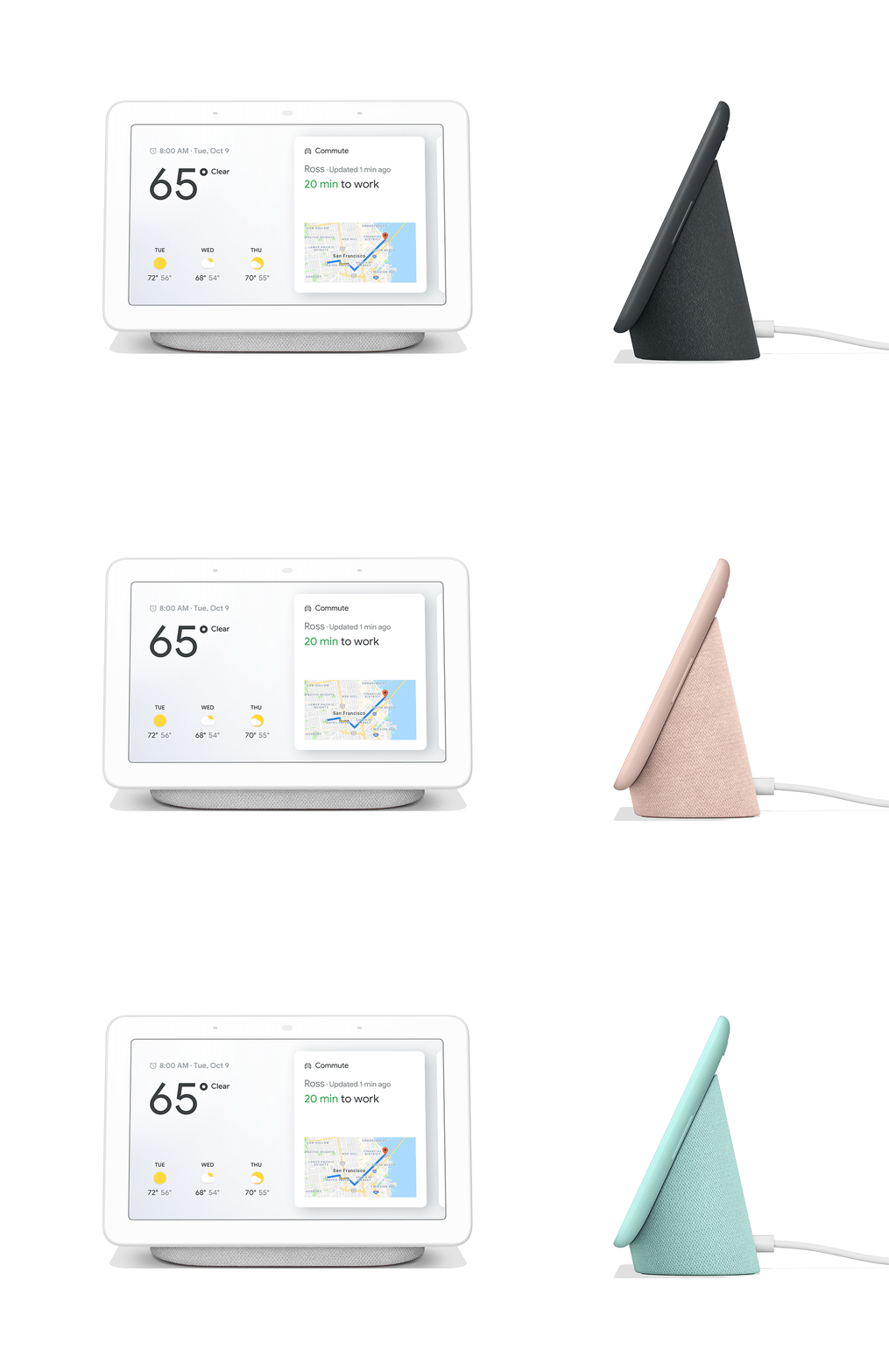
Google already has voice-controlled assistants but this adds a 7-inch screen, so you can ask it for maps, for videos, for photos, for music, for recipes, you can look at your calendar, and so on. Plus it’ll connect with compatible smart home devices to dim your lights, adjust the thermostat or watch security cameras.
Google’s Home Hub is currently only available in the UK (£139), the USA and Australia.
iBubble underwater drone
This is described as “the world’s first intelligent autonomous and fully wireless underwater drone”. It’s from a French company called Notilo Plus, which specialises in underwater exploration, and essentially it’s a remote-control submarine that can drive itself.
You fit your camera inside, strap on your special wristband and the iBubble will follow you underwater for up to an hour and down to 60 metres - almost 200 feet - without bumping into things. You can tell it to follow you, to go ahead of you, to film from the side, to circle around you, to come to you or to stay still. It can also be connected to an optional cable and directly controlled from the surface using an app on your phone or tablet.
The retail price of the iBubble is $4,099 (around €3,600), excluding VAT and the cost of a camera. It’s designed to work with newer models of GoPro and other action cameras that use the same type of mount.
Palm smartphone
Remember Palm organisers? Well, the Palm name is back – and this time it’s on a tiny smartphone that saves you from taking your regular smartphone out of your pocket or bag. It weighs 62½ grams, it’s 50mm wide by 97mm tall and it’s 7.4mm thick. On the front is a 3.3-inch touchscreen and inside is a Qualcomm Snapdragon processor running the Android operating system. The front and back are made from Gorilla Glass 3 and the phone is rated for IP68 water and dust protection. It even finds room for a 12 megapixel camera on the back and an 8 megapixel camera on the front.
What’s the point? Well, I suppose it’s a bit like having a smartwatch on your wrist – except this is potentially smarter but not quite so convenient. This 'companion phone' connects to your regular mobile number, so you can leave your big expensive phone at home and just take the little one.
There are two bits of bad news for Palm fans. Firstly, there’s not really any connection with the old company except the name. And the new Palm phone is currently only available from the Verizon network in the United States. So even if you spend $349.99 to get hold of one, you’ll need another phone on a Verizon contract to make it work.
Facebook Portal video screen
Facebook Portal is a smart display screen that offers hands-free video calling. There’s a choice of two devices: one has a 10.1-inch screen and one has a 15.6-inch screen (the bigger one is called the Portal+; it’s better quality and can also be adjusted more, but other than that they’re pretty similar). Both have Amazon's Alexa voice-controlled personal assistant service built in. They also have Facebook Messenger and a 12-megapixel camera, which means you can chat via video, with facial recognition enabling it to automatically zoom in on your face as you move about. So if your friends have got Facebook Messenger on their smartphone or their tablet, you can ask your Facebook Portal to call them. And because it runs on Amazon Alexa, you can also ask for sports results, weather forecasts, listen to music, do your shopping or control smart home devices. It can even be a picture frame when you’re not using it.
At the moment both devices are only available for pre-order in the United States, with the regular Portal costing $199.
Google Home Hub
Facebook has its Portal, Amazon has its Echo Show, now Google has its Home Hub. This is another voice and touch controlled information centre for your house. However, unlike the Portal, there’s no camera – so you might feel happier about having it in the bedroom.
Google already has voice-controlled assistants but this adds a 7-inch screen, so you can ask it for maps, for videos, for photos, for music, for recipes, you can look at your calendar, and so on. Plus it’ll connect with compatible smart home devices to dim your lights, adjust the thermostat or watch security cameras.
Google’s Home Hub is currently only available in the UK (£139), the USA and Australia.
iBubble underwater drone
This is described as “the world’s first intelligent autonomous and fully wireless underwater drone”. It’s from a French company called Notilo Plus, which specialises in underwater exploration, and essentially it’s a remote-control submarine that can drive itself.
You fit your camera inside, strap on your special wristband and the iBubble will follow you underwater for up to an hour and down to 60 metres - almost 200 feet - without bumping into things. You can tell it to follow you, to go ahead of you, to film from the side, to circle around you, to come to you or to stay still. It can also be connected to an optional cable and directly controlled from the surface using an app on your phone or tablet.
The retail price of the iBubble is $4,099 (around €3,600), excluding VAT and the cost of a camera. It’s designed to work with newer models of GoPro and other action cameras that use the same type of mount.
Tuesday, 25 September 2018
My TRE Talk Radio Europe technology for September 2018
Here's a summary of the tech I mentioned in this afternoon's 'gadget guru' chat on TRE Talk Radio Europe:
Apple Watch 4
This month Apple has announced three new iPhones - the iPhone XS, the iPhone XS Max and the iPhone XR - as well as a new Apple Watch. The smartwatch is particularly notable because it includes a couple of impressive features.
Probably the most significant update from previous models is that the Series 4 Apple Watch can act as an electrocardiogram (ECG). There are electrodes built into the front and there’s a heart rate sensor in the back. If you’re concerned about heart health, these readings could help you - and help your doctor, too.
The other major new feature is a fall detector: if you fall over, the watch can sense this and call for help.
There''s a choice of two sizes and various specifications: pricing starts from £399 / €429.
Vivosmart 4 fitness wristband
The new Garmin Vivosmart 4 is – as the name suggests – the fourth generation of this particular fitness-focussed smart wristband. What’s so special? It includes a pulse oximeter, which can keep track of your blood oxygen level. This helps with tracking your sleep; not just the amount but the quality as well.
It also includes a heart rate monitor that links with your stress level and your sleep quality to work out the best time for you to start a workout.
Pricing is around £120 (€135).
Segway Drift W1 electronic skates
Remember the Segway, which was an incredibly clever two-wheeled platform that you could stand on and ride? There was just one problem: in the UK (and an assortment of other countries) you couldn’t ride it on the road – and you couldn’t ride it on the pavement either.
Since the launch of the Segway PT in 2001, the company has changed ownership a couple of times – but it's not gone away.
And so we're introduced to the Segway Drift W1. These, according to the company, are self-balancing e-Skates. In reality, they have the appearance of a motorised roller skate crossed with platform shoes. Pricing is £359 (just over €400), with delivery expected next month.
When you stand on the skates, you'll find they balance themselves, so all you need to do is lean forwards to go and lean sideways to steer. Your maximum speed is 7½ mph (12km/h), which is two or three times faster than walking, and your rechargeable batteries will keep you moving for up to 45 minutes.
Just one bit of bad news. Unfortunately, it’s not just the technology that’s similar to the original – it’s also the legal situation. Here in the UK, usage is restricted to private property – with the owner’s permission, of course.
Locky smart key
Gnerally speaking, smart locks have one big disadvantage: you need to change the lock in your door. But what if you could keep your lock and turn your key into a smart key? That’s exactly what this particular Kickstarter project is all about.
Locky is a little device that clips onto your key, like a fancy key cover. Inside that fancy cover is a tiny battery that lasts for around a year, some clever sensors and a Bluetooth connection.
Basically, the sensors work out if you’ve turned your key in the lock. The Bluetooth connection then links with an application on your phone to warn you if you’ve left home without locking the house. It’s also capable of warning you if you’ve left your key behind and can even help you find the key if you put it down somewhere. Plus it keeps a record of key use, so if all your family have a Locky on their key, you know if someone’s in and when they returned.
Most importantly, it’s still a mechanical key. It can’t be hacked and it unlocks your door even if the battery goes flat.
The company reckons they’ll start shipping these in March next year for around £60 each but there are currently special offers if you commit early.
Apple Watch 4
This month Apple has announced three new iPhones - the iPhone XS, the iPhone XS Max and the iPhone XR - as well as a new Apple Watch. The smartwatch is particularly notable because it includes a couple of impressive features.
Probably the most significant update from previous models is that the Series 4 Apple Watch can act as an electrocardiogram (ECG). There are electrodes built into the front and there’s a heart rate sensor in the back. If you’re concerned about heart health, these readings could help you - and help your doctor, too.
The other major new feature is a fall detector: if you fall over, the watch can sense this and call for help.
There''s a choice of two sizes and various specifications: pricing starts from £399 / €429.
Vivosmart 4 fitness wristband
The new Garmin Vivosmart 4 is – as the name suggests – the fourth generation of this particular fitness-focussed smart wristband. What’s so special? It includes a pulse oximeter, which can keep track of your blood oxygen level. This helps with tracking your sleep; not just the amount but the quality as well.
It also includes a heart rate monitor that links with your stress level and your sleep quality to work out the best time for you to start a workout.
Pricing is around £120 (€135).
Segway Drift W1 electronic skates
Remember the Segway, which was an incredibly clever two-wheeled platform that you could stand on and ride? There was just one problem: in the UK (and an assortment of other countries) you couldn’t ride it on the road – and you couldn’t ride it on the pavement either.
Since the launch of the Segway PT in 2001, the company has changed ownership a couple of times – but it's not gone away.
And so we're introduced to the Segway Drift W1. These, according to the company, are self-balancing e-Skates. In reality, they have the appearance of a motorised roller skate crossed with platform shoes. Pricing is £359 (just over €400), with delivery expected next month.
When you stand on the skates, you'll find they balance themselves, so all you need to do is lean forwards to go and lean sideways to steer. Your maximum speed is 7½ mph (12km/h), which is two or three times faster than walking, and your rechargeable batteries will keep you moving for up to 45 minutes.
Just one bit of bad news. Unfortunately, it’s not just the technology that’s similar to the original – it’s also the legal situation. Here in the UK, usage is restricted to private property – with the owner’s permission, of course.
Locky smart key
Gnerally speaking, smart locks have one big disadvantage: you need to change the lock in your door. But what if you could keep your lock and turn your key into a smart key? That’s exactly what this particular Kickstarter project is all about.
Locky is a little device that clips onto your key, like a fancy key cover. Inside that fancy cover is a tiny battery that lasts for around a year, some clever sensors and a Bluetooth connection.
Basically, the sensors work out if you’ve turned your key in the lock. The Bluetooth connection then links with an application on your phone to warn you if you’ve left home without locking the house. It’s also capable of warning you if you’ve left your key behind and can even help you find the key if you put it down somewhere. Plus it keeps a record of key use, so if all your family have a Locky on their key, you know if someone’s in and when they returned.
Most importantly, it’s still a mechanical key. It can’t be hacked and it unlocks your door even if the battery goes flat.
The company reckons they’ll start shipping these in March next year for around £60 each but there are currently special offers if you commit early.
Tuesday, 21 August 2018
TRE Talk Radio Europe 'gadget guru' technology for August 2018
Here is a quick reminder of the technology I mentioned in today's conversation with Dave Hodgson on TRE Talk Radio Europe:
Samsung Galaxy Note9
Is it a giant phone or a small tablet? Either way, the newest member of the Samsung Galaxy Note dynasty looks pretty similar to its predecessors at first glance... but there are some substantial differences when you get closer. What we find is a bigger screen than ever - this one is 6.4 inches from corner to corner, with 2960 by 1440 pixel resolution - and a faster processor than the Note 8.
The stylus on the new Note9 also takes a leap forwards because it has a Bluetooth connection. Inside is a tiny rechargeable battery that means the pen isn't just for drawing on the screen but can be used as a remote control for the camera, to play and pause videos you're watching, even to control an on-screen presentation, And best of all, the battery recharges whenever you pop it back into its storage slot inside the phone.
Will toe 4000mAh battery last all day? That depends what you're doing with the phone but, for most of us, I'd say it will. Equally high capacity is the storage: there are various versions of the Note9 available including one with 512GB of built-in memory.
Plus, of course, it's got a camera - there's a dual-lens 12 megapixel set-up - and built-in stereo speakers that have been tuned by audio specialists AKG. There's even a headphone socket, which is always a good thing as far as I'm concerned.
Pricing depends on the amount of built-in memory you want, starting from £899 contract-free.
Apple MacBooks
Here we have two new laptops from Apple. one with a 13-inch screen and one with a 15-inch screen. Although neither of these are touch-sensitive screens they are impressively high quality and there is a touch-sensitive bar at the top of the keyboard instead of conventional function keys. This was introduced a couple of years ago and changes its appearance depending on what you're doing.
However, the main keyboard is brand new. Apple says it's now quieter - and if you don’t want to type, both devices include voice-control app Siri.
Also inside is a choice of faster processors. The 13-inch model now runs quad-core chips rather than dual-core chips, which means it'll be up to twice as fast, while the 15-inch one has six-core processors, giving you up to 70% more speed. There's more system memory, which is all about running programs more effectively, and up to 4TB of solid state storage.
Pricing is from £1,749 for the base spec 13-inch model up to £6,209 if you want the highest specification of 15-inch MacBook.
Travis Touch translator
This is a translation device that can translate and understand over a hundred languages. Because it’s a separate hand-held device, you don’t need to worry about opening an app on your phone and running the battery flat.
The designers have built in technology from sixteen different translation services, including Google, Microsoft and IBM. Travis Touch then chooses the best service depending on the language you’re using and the language you’re translating to. It’s designed to use WiFi or a mobile connection and has its own SIM card slot, although it can do some basic stuff without being online.
There’s a 2.4-inch touch screen for controlling the device – hence the name – but you can also use voice commands in English, Spanish, Chinese, Korean and Japanese to select the languages you need. You simply speak to it and it’ll speak the translation back to you.
Pricing is expected to be $269 when it arrives in shops, although there’s currently an option to pay less if you order via crowd-funding site Indiegogo.
Nespresso Barista
Nespresso is a company that’s become well-known for making coffee pod machines.
The Nespresso Barista is not one of those machines. It’s more like a companion for those machines. You make an espresso, then the Barista turns it into a cappuccino or a latte or an iced coffee...
The design looks a bit like a Thermos flask crossed with a Bluetooth loudspeaker; it plugs into the mains and stands 21cm high. There's a base with a metal jug that fits on top, a whisk that clips inside and a lid.
On the base is a touch-sensitive display with a choice of coffee options. You select the one you want – let's say a cappuccino – and then put all the ingredients you need into the jug. The device heats the milk, whisks it up and you pour it onto your espresso. It comes with a little recipe book, so if you’re not sure what you should be doing with your iced coffee or your mocha, you can check first.
It can also connect with an app on your phone to get updates for new recipes.
The only real downsides are that it’s pretty much just making one cup at a time and it doesn’t brew the coffee for you. But, as an alternative to an all-in-one machine, this is more affordable – and it’s way more sophisticated than a mere milk frother. Pricing is around £179 (€195).
Samsung Galaxy Note9
Is it a giant phone or a small tablet? Either way, the newest member of the Samsung Galaxy Note dynasty looks pretty similar to its predecessors at first glance... but there are some substantial differences when you get closer. What we find is a bigger screen than ever - this one is 6.4 inches from corner to corner, with 2960 by 1440 pixel resolution - and a faster processor than the Note 8.
The stylus on the new Note9 also takes a leap forwards because it has a Bluetooth connection. Inside is a tiny rechargeable battery that means the pen isn't just for drawing on the screen but can be used as a remote control for the camera, to play and pause videos you're watching, even to control an on-screen presentation, And best of all, the battery recharges whenever you pop it back into its storage slot inside the phone.
Will toe 4000mAh battery last all day? That depends what you're doing with the phone but, for most of us, I'd say it will. Equally high capacity is the storage: there are various versions of the Note9 available including one with 512GB of built-in memory.
Plus, of course, it's got a camera - there's a dual-lens 12 megapixel set-up - and built-in stereo speakers that have been tuned by audio specialists AKG. There's even a headphone socket, which is always a good thing as far as I'm concerned.
Pricing depends on the amount of built-in memory you want, starting from £899 contract-free.
Apple MacBooks
Here we have two new laptops from Apple. one with a 13-inch screen and one with a 15-inch screen. Although neither of these are touch-sensitive screens they are impressively high quality and there is a touch-sensitive bar at the top of the keyboard instead of conventional function keys. This was introduced a couple of years ago and changes its appearance depending on what you're doing.
However, the main keyboard is brand new. Apple says it's now quieter - and if you don’t want to type, both devices include voice-control app Siri.
Also inside is a choice of faster processors. The 13-inch model now runs quad-core chips rather than dual-core chips, which means it'll be up to twice as fast, while the 15-inch one has six-core processors, giving you up to 70% more speed. There's more system memory, which is all about running programs more effectively, and up to 4TB of solid state storage.
Pricing is from £1,749 for the base spec 13-inch model up to £6,209 if you want the highest specification of 15-inch MacBook.
Travis Touch translator
This is a translation device that can translate and understand over a hundred languages. Because it’s a separate hand-held device, you don’t need to worry about opening an app on your phone and running the battery flat.
The designers have built in technology from sixteen different translation services, including Google, Microsoft and IBM. Travis Touch then chooses the best service depending on the language you’re using and the language you’re translating to. It’s designed to use WiFi or a mobile connection and has its own SIM card slot, although it can do some basic stuff without being online.
There’s a 2.4-inch touch screen for controlling the device – hence the name – but you can also use voice commands in English, Spanish, Chinese, Korean and Japanese to select the languages you need. You simply speak to it and it’ll speak the translation back to you.
Pricing is expected to be $269 when it arrives in shops, although there’s currently an option to pay less if you order via crowd-funding site Indiegogo.
Nespresso Barista
Nespresso is a company that’s become well-known for making coffee pod machines.
The Nespresso Barista is not one of those machines. It’s more like a companion for those machines. You make an espresso, then the Barista turns it into a cappuccino or a latte or an iced coffee...
The design looks a bit like a Thermos flask crossed with a Bluetooth loudspeaker; it plugs into the mains and stands 21cm high. There's a base with a metal jug that fits on top, a whisk that clips inside and a lid.
On the base is a touch-sensitive display with a choice of coffee options. You select the one you want – let's say a cappuccino – and then put all the ingredients you need into the jug. The device heats the milk, whisks it up and you pour it onto your espresso. It comes with a little recipe book, so if you’re not sure what you should be doing with your iced coffee or your mocha, you can check first.
It can also connect with an app on your phone to get updates for new recipes.
The only real downsides are that it’s pretty much just making one cup at a time and it doesn’t brew the coffee for you. But, as an alternative to an all-in-one machine, this is more affordable – and it’s way more sophisticated than a mere milk frother. Pricing is around £179 (€195).
Tuesday, 24 July 2018
July 2018 'gadget guru' tech for TRE Talk Radio Europe
Here's a reminder of the technology I talked about in my July 2018 TRE Talk Radio Europe 'gadget guru' chat:
BlackBerry KEY2
A long, long time ago in the world of mobile phones – about ten years, I suppose – if you needed a phone for work, there was really only one brand to consider: BlackBerry. Not least because BlackBerry phones had a physical keyboard for writing your email messages.
BlackBerry is still around – and last month it launched the KEY2 smartphone, which it’s calling ‘the most advanced BlackBerry smartphone yet’. Actually, to be totally correct, it’s TCL Communication that’s making the phone: they’ve licensed the BlackBerry brand.
What do you get? Well, you still have a physical keyboard, now combined with a 4.5-inch touchscreen as well. In fact, this keyboard is improved even from the previous model; the keys are 20% higher is should make them more comfortable and more accurate to use. And when you don’t need a keyboard, it can function as a trackpad for scrolling though web pages.
Pricing is around €649 (£579) without a contract. If you want a smartphone for business – especially if your business involves writing a lot – it’s certainly worth looking at. If you want a phone for watching videos and taking photos, there’s plenty of competition.
Square Off
This looks like a conventional chess board with wooden pieces, although it’s a bit thicker than usual and you’ll spot a charging socket and an on/off switch if you look closely. You set it up as normal - the pieces are magnetic - and then get ready to play. Each square is an inch-and-a-half across, to give you some idea of scale.
The board can connect wirelessly with your phone, turning it into a chess computer with different levels of play. But unlike most other chess computers, you don’t need to move your opponent’s pieces: the board moves them itself, using a magnetic arm that’s hidden underneath.
The manufacturers also say you’ll soon be able to play against millions of other people around the world. That’s where the mobile phone connection really comes into its own. If each of you has a Square Off board, you’ll see your opponent’s pieces move on your board. On the other hand, you’ll be able to play against people who don’t have a board as long as they’ve got the right app on their phone.
There are two versions available: the regular one is currently on sale for $329 (around €280) plus shipping; there’s also an even smarter one for $399. The dearer version includes space on the board for captured pieces and what’s undoubtedly my favourite feature: a reset button that sends all the chess pieces back to their original positions when the game is over.
Nano Cure Tent
The premise behind this is pretty simple: if you snag a regular tent on a fence or on brambles, it lets in the water. This particular tent is made from high-tech fabric that seals little holes if you rub them with your fingers.
What actually happens is that the fabric doesn’t actually break but the fibres are pushed apart when it’s pierced. Rubbing it with your fingers causes those fibres to move back into shape.
Up to four people can sleep in the tent; it's is available for $200 (around €170) via crowd-funding site Kickstarter.com and, if all goes well, they’re expecting to start shipping in December.
FOCI
This is a biometric wearable that's all about focusing on your work and not getting distracted so much. And yes, there’s surely a fair amount of irony that you’re using an electronic device in order to stop being distracted by electronic devices.
Foci clips to your waist, perhaps your belt or whatever else you’re wearing. It claims to track focus, distraction, stress and fatigue, with feedback shown on your phone as a coloured ball. The device itself will vibrate when your focus drops. If this happens, the app can guide you to get you back into 'the zone'.
You’re probably wondering how Foci works. The answer is that the device monitors small differences in your breathing between when you’re focused and when you’re distracted. These readings are sent wirelessly to your mobile phone and processed by the UK-based company behind all this. As well as getting instant feedback you can also see how you’ve performed on previous days.
I’ve not used one but from the reviews I’ve seen it seems to work well although it’s (understandably) not perfect, which in itself could be a distraction.
This is another crowd-funded product: at the moment, you can order via Indiegogo for $73.
BlackBerry KEY2
A long, long time ago in the world of mobile phones – about ten years, I suppose – if you needed a phone for work, there was really only one brand to consider: BlackBerry. Not least because BlackBerry phones had a physical keyboard for writing your email messages.
BlackBerry is still around – and last month it launched the KEY2 smartphone, which it’s calling ‘the most advanced BlackBerry smartphone yet’. Actually, to be totally correct, it’s TCL Communication that’s making the phone: they’ve licensed the BlackBerry brand.
What do you get? Well, you still have a physical keyboard, now combined with a 4.5-inch touchscreen as well. In fact, this keyboard is improved even from the previous model; the keys are 20% higher is should make them more comfortable and more accurate to use. And when you don’t need a keyboard, it can function as a trackpad for scrolling though web pages.
Pricing is around €649 (£579) without a contract. If you want a smartphone for business – especially if your business involves writing a lot – it’s certainly worth looking at. If you want a phone for watching videos and taking photos, there’s plenty of competition.
Square Off
This looks like a conventional chess board with wooden pieces, although it’s a bit thicker than usual and you’ll spot a charging socket and an on/off switch if you look closely. You set it up as normal - the pieces are magnetic - and then get ready to play. Each square is an inch-and-a-half across, to give you some idea of scale.
The board can connect wirelessly with your phone, turning it into a chess computer with different levels of play. But unlike most other chess computers, you don’t need to move your opponent’s pieces: the board moves them itself, using a magnetic arm that’s hidden underneath.
The manufacturers also say you’ll soon be able to play against millions of other people around the world. That’s where the mobile phone connection really comes into its own. If each of you has a Square Off board, you’ll see your opponent’s pieces move on your board. On the other hand, you’ll be able to play against people who don’t have a board as long as they’ve got the right app on their phone.
There are two versions available: the regular one is currently on sale for $329 (around €280) plus shipping; there’s also an even smarter one for $399. The dearer version includes space on the board for captured pieces and what’s undoubtedly my favourite feature: a reset button that sends all the chess pieces back to their original positions when the game is over.
Nano Cure Tent
The premise behind this is pretty simple: if you snag a regular tent on a fence or on brambles, it lets in the water. This particular tent is made from high-tech fabric that seals little holes if you rub them with your fingers.
What actually happens is that the fabric doesn’t actually break but the fibres are pushed apart when it’s pierced. Rubbing it with your fingers causes those fibres to move back into shape.
Up to four people can sleep in the tent; it's is available for $200 (around €170) via crowd-funding site Kickstarter.com and, if all goes well, they’re expecting to start shipping in December.
FOCI
This is a biometric wearable that's all about focusing on your work and not getting distracted so much. And yes, there’s surely a fair amount of irony that you’re using an electronic device in order to stop being distracted by electronic devices.
Foci clips to your waist, perhaps your belt or whatever else you’re wearing. It claims to track focus, distraction, stress and fatigue, with feedback shown on your phone as a coloured ball. The device itself will vibrate when your focus drops. If this happens, the app can guide you to get you back into 'the zone'.
You’re probably wondering how Foci works. The answer is that the device monitors small differences in your breathing between when you’re focused and when you’re distracted. These readings are sent wirelessly to your mobile phone and processed by the UK-based company behind all this. As well as getting instant feedback you can also see how you’ve performed on previous days.
I’ve not used one but from the reviews I’ve seen it seems to work well although it’s (understandably) not perfect, which in itself could be a distraction.
This is another crowd-funded product: at the moment, you can order via Indiegogo for $73.
Wednesday, 6 June 2018
June 2018 'gadget guru' technology: TRE Talk Radio Europe
Here's a summary of the technology I talked about in this month's 'gadget guru' chat on TRE Talk Radio Europe:
Apple iOS 12 operating system
Last year Apple used its Worldwide Developer Conference as an opportunity to announce a new intelligent loudspeaker for the home, a new iPad and new desktop computers. This year it’s all about the software: iOS 12, which is a new version of software for iPhones and iPads.
Apple iOS 12 is all about being faster, more secure and more reliable. Apple says applications will generally be quicker to start and the camera will be ready up to 70% faster. You can train Siri, the voice activated assistant on your iPhone, to work with apps. And it’s better at working things out itself, so if you’re running late for a meeting it’ll offer to send apologetic messages and if you’re in the cinema it’ll remind you to turn the ringer off. But the big thing that’s grabbed a lot of attention is the opposite of this: the Do Not Disturb option, which has been improved to make it easier for you to ignore your phone. You can make this time-based or location-based, so it’ll go quiet when you’re visiting the library and will switch the alerts back on when you leave. There’s also a timer to limit access for children and perhaps for yourself, along with reports to see what you’re using your phone for and when you’re using it most.
iOS 12 is available this month as a beta version for people who fancy testing it - and for everyone else it’ll be online in the Autumn as a free download for everything from the iPhone 5s and iPad version 5 onwards.
Sony DPT-CP1 digital paper tablet
While Apple and its many competitors are busy making devices with bright, colourful screens, Sony is one of the few manufacturers that hasn’t given up with what are often called electronic ink or e-ink displays. These look like paper and actually feel a bit like paper, because the screen isn’t glossy but has a slightly rough texture. What’s the point? Well, a screen that isn’t shiny is much easier to see in the sun. Great for reading electronic books, for example. And if you’re relying on ambient light rather than a backlit display, it’s often easier on your eyes, too.
The new Sony CP1 is pretty much the digital equivalent of an A5 piece of paper; with a 10.3 inch screen that has a resolution of 1,404 pixels by 1,872 pixels. The whole thing is less than 6mm thick and, because it doesn't have a colour display, the battery is likely to last for over a week between charges. It’s got 16GB of storage and can share pdf document files with Apple, Android and Windows devices via an app. But it’s not just a reader: you can also write on it with a stylus, either creating new documents or making notes on existing documents. It’s on sale in Japan and America for $599.99 [just over €500].
ASUS ZenBook Pro 15
A new laptop isn’t generally all that exciting. But there’s an innovation on this the new ASUS ZenBook Pro 15 that’s worth talking about. And, indeed, on the ZenBook Pro 14, which is similar but a bit smaller. The Pro 15 model has a 15.6-inch 4K ultraHD display that’s said to be particularly good at rendering colours accurately. On the back is a new type of hinge design that ASUS calls ErgoLift, which slightly raises the laptop keyboard to make typing easier. And inside is an Intel Core i9 processor, a 1TB solid state disc and a copy of Windows. It’s less than 2cm thick, it weighs less than 2kg and it’s expected to sell for around $2,299 [€2000] when it goes on sale next month. So far, so good.
But the interesting part is the touchpad. Usually you’d expect a grey touch-sensitive pad below the keyboard. On here there’s a 5½-inch colour touch screen, so it looks like a mobile phone embedded in your laptop. It works as a mouse substitute – and it can also work as a tiny laptop screen, perhaps for messaging, as a calculator, for playing music or for checking your diary.
Ovis suitcase with AI
Whether you’re going on holiday or on a business trip, dragging a suitcase behind you can be – well, a bit of a pain. If only your suitcase had some kind of robot brain to steer itself alongside you as you walked. Believe it or not, that’s exactly what is being offered here. It’s a self-driving hands-free intelligent suitcase created by a Chinese company called ForwardX Robotics.
Unlike a regular suitcase, this one has a camera connected to a Qualcomm processor running an artificial neural network that does its best to understand what it sees. It's the same kind of technology you get in self-driving cars. The case keeps up with you at a speed of 3 metres per second but when you grab the handle it cuts the motor automatically and turns into a conventional suitcase. That’s also good news if you forget to charge it because, as you’d expect, it runs from rechargeable batteries. If you’re worried about security, there’s a wristband you wear that vibrates when your case is more than a couple of metres away from you and also lets you know when the battery is running down. You also have the option of GPS tracking for an extra cost. It’s not perfect: it can only handle a slope of up to 6 degrees and it doesn’t cope well in very crowded places, but that’s no great surprise, really.
Shipping for the first batch is expected by the end of the year: at the moment you can find it on crowd-funding site Indiegogo, where you can pledge $319 [€275] for a single suitcase.
Apple iOS 12 operating system
Last year Apple used its Worldwide Developer Conference as an opportunity to announce a new intelligent loudspeaker for the home, a new iPad and new desktop computers. This year it’s all about the software: iOS 12, which is a new version of software for iPhones and iPads.
Apple iOS 12 is all about being faster, more secure and more reliable. Apple says applications will generally be quicker to start and the camera will be ready up to 70% faster. You can train Siri, the voice activated assistant on your iPhone, to work with apps. And it’s better at working things out itself, so if you’re running late for a meeting it’ll offer to send apologetic messages and if you’re in the cinema it’ll remind you to turn the ringer off. But the big thing that’s grabbed a lot of attention is the opposite of this: the Do Not Disturb option, which has been improved to make it easier for you to ignore your phone. You can make this time-based or location-based, so it’ll go quiet when you’re visiting the library and will switch the alerts back on when you leave. There’s also a timer to limit access for children and perhaps for yourself, along with reports to see what you’re using your phone for and when you’re using it most.
iOS 12 is available this month as a beta version for people who fancy testing it - and for everyone else it’ll be online in the Autumn as a free download for everything from the iPhone 5s and iPad version 5 onwards.
Sony DPT-CP1 digital paper tablet
While Apple and its many competitors are busy making devices with bright, colourful screens, Sony is one of the few manufacturers that hasn’t given up with what are often called electronic ink or e-ink displays. These look like paper and actually feel a bit like paper, because the screen isn’t glossy but has a slightly rough texture. What’s the point? Well, a screen that isn’t shiny is much easier to see in the sun. Great for reading electronic books, for example. And if you’re relying on ambient light rather than a backlit display, it’s often easier on your eyes, too.
The new Sony CP1 is pretty much the digital equivalent of an A5 piece of paper; with a 10.3 inch screen that has a resolution of 1,404 pixels by 1,872 pixels. The whole thing is less than 6mm thick and, because it doesn't have a colour display, the battery is likely to last for over a week between charges. It’s got 16GB of storage and can share pdf document files with Apple, Android and Windows devices via an app. But it’s not just a reader: you can also write on it with a stylus, either creating new documents or making notes on existing documents. It’s on sale in Japan and America for $599.99 [just over €500].
ASUS ZenBook Pro 15
A new laptop isn’t generally all that exciting. But there’s an innovation on this the new ASUS ZenBook Pro 15 that’s worth talking about. And, indeed, on the ZenBook Pro 14, which is similar but a bit smaller. The Pro 15 model has a 15.6-inch 4K ultraHD display that’s said to be particularly good at rendering colours accurately. On the back is a new type of hinge design that ASUS calls ErgoLift, which slightly raises the laptop keyboard to make typing easier. And inside is an Intel Core i9 processor, a 1TB solid state disc and a copy of Windows. It’s less than 2cm thick, it weighs less than 2kg and it’s expected to sell for around $2,299 [€2000] when it goes on sale next month. So far, so good.
But the interesting part is the touchpad. Usually you’d expect a grey touch-sensitive pad below the keyboard. On here there’s a 5½-inch colour touch screen, so it looks like a mobile phone embedded in your laptop. It works as a mouse substitute – and it can also work as a tiny laptop screen, perhaps for messaging, as a calculator, for playing music or for checking your diary.
Ovis suitcase with AI
Whether you’re going on holiday or on a business trip, dragging a suitcase behind you can be – well, a bit of a pain. If only your suitcase had some kind of robot brain to steer itself alongside you as you walked. Believe it or not, that’s exactly what is being offered here. It’s a self-driving hands-free intelligent suitcase created by a Chinese company called ForwardX Robotics.
Unlike a regular suitcase, this one has a camera connected to a Qualcomm processor running an artificial neural network that does its best to understand what it sees. It's the same kind of technology you get in self-driving cars. The case keeps up with you at a speed of 3 metres per second but when you grab the handle it cuts the motor automatically and turns into a conventional suitcase. That’s also good news if you forget to charge it because, as you’d expect, it runs from rechargeable batteries. If you’re worried about security, there’s a wristband you wear that vibrates when your case is more than a couple of metres away from you and also lets you know when the battery is running down. You also have the option of GPS tracking for an extra cost. It’s not perfect: it can only handle a slope of up to 6 degrees and it doesn’t cope well in very crowded places, but that’s no great surprise, really.
Shipping for the first batch is expected by the end of the year: at the moment you can find it on crowd-funding site Indiegogo, where you can pledge $319 [€275] for a single suitcase.
Tuesday, 8 May 2018
TRE Talk Radio Europe 'gadget guru' technology for May 2018
Here's a summary of the technology I mentioned in this month's TRE Talk Radio Europe 'gadget guru' chat:
Snapchat Spectacles
In simple terms, Snapchat enables you to send photos and videos from your phone to your friends. A couple of years ago, the company behind Snapchat launched some sunglasses with a built-in video camera. A hands-free camera, you might say. And now, as summer 2018 heads towards us, we can now buy version 2 of the Snapchat Spectacles. Are they better? Yes, they are. To start with, the design has been tweaked: still very retro but now less bulky. The new specs can take photos as well as videos. And they’re water resistant, which I’m sure is more about taking them to the beach rather than wearing them in the rain. The sound quality has been improved, picture quality is better and there’s faster wireless transfer when sending everything to your phone. As before, they come with a carrying case that includes a rechargeable battery, so you can recharge up to four times when you’re out and about. Pricing is £149.99.
FinalStraw
This is, quite simply, a personal folding straw. It fits in a little case that attaches to your key ring and it pops into shape when you take it out. What’s rather nice is there’s also room for a little cleaning tool in the case – although it’s also able to go in a dishwasher. Outside, the straw is stainless steel. Inside it’s medical-grade TPE (Thermoplastic Elastomer). The whole thing fits inside a case that’s 7.3cm long but the straw extends to 23cm (9 inches). Shipping is expected by the end of the year; at the moment you can pledge around £15 (€17) plus shipping for one, via crowd-funding site Kickstarter.
Tennibot
If you play tennis, you may well want an autonomous robot that collects tennis balls. This thing looks like a cross between a tiny wheelbarrow and a shopping trolley that’s fallen over: three foot long and 16 inches wide. You could say it works in a similar way to a robot vacuum cleaner, although it also has a separate camera sensor that you clip onto the net post. Overall control is from an app on your phone. It’ll hold up to 80 balls, it travels at up to 1.4mph and it’ll run for up to five hours on a 90 minute battery charge. On Kickstarter you can pledge the equivalent of $700 (about £520 / €590), which is 30% off the expected retail price (excluding shipping and import taxes). Delivery is expected January 2019.
Diveroid Mini
Here's a device for scuba divers that turns an Android or Apple smartphone into a dive computer. What you get is a battery-powered waterproof sensor that’s slightly less than two inches across. This connects wirelessly via Bluetooth to an app on your phone. (You’ll need to put your phone inside a waterproof case before you hit the water; the sensor then clips to the outside of this.) When the Diveroid sensor is connected to your phone, you’ll get an interactive dive computer with an on-screen compass, a logbook you can share with other divers plus automatic colour correction for underwater photos and videos. You’ll get warnings if you’re going too deep or coming to the surface too quickly. Product delivery is due from the end of July; current pricing is $89 (approx. €75) plus shipping via crowd-funded site Indiegogo.
Snapchat Spectacles
In simple terms, Snapchat enables you to send photos and videos from your phone to your friends. A couple of years ago, the company behind Snapchat launched some sunglasses with a built-in video camera. A hands-free camera, you might say. And now, as summer 2018 heads towards us, we can now buy version 2 of the Snapchat Spectacles. Are they better? Yes, they are. To start with, the design has been tweaked: still very retro but now less bulky. The new specs can take photos as well as videos. And they’re water resistant, which I’m sure is more about taking them to the beach rather than wearing them in the rain. The sound quality has been improved, picture quality is better and there’s faster wireless transfer when sending everything to your phone. As before, they come with a carrying case that includes a rechargeable battery, so you can recharge up to four times when you’re out and about. Pricing is £149.99.
FinalStraw
This is, quite simply, a personal folding straw. It fits in a little case that attaches to your key ring and it pops into shape when you take it out. What’s rather nice is there’s also room for a little cleaning tool in the case – although it’s also able to go in a dishwasher. Outside, the straw is stainless steel. Inside it’s medical-grade TPE (Thermoplastic Elastomer). The whole thing fits inside a case that’s 7.3cm long but the straw extends to 23cm (9 inches). Shipping is expected by the end of the year; at the moment you can pledge around £15 (€17) plus shipping for one, via crowd-funding site Kickstarter.
Tennibot
If you play tennis, you may well want an autonomous robot that collects tennis balls. This thing looks like a cross between a tiny wheelbarrow and a shopping trolley that’s fallen over: three foot long and 16 inches wide. You could say it works in a similar way to a robot vacuum cleaner, although it also has a separate camera sensor that you clip onto the net post. Overall control is from an app on your phone. It’ll hold up to 80 balls, it travels at up to 1.4mph and it’ll run for up to five hours on a 90 minute battery charge. On Kickstarter you can pledge the equivalent of $700 (about £520 / €590), which is 30% off the expected retail price (excluding shipping and import taxes). Delivery is expected January 2019.
Diveroid Mini
Here's a device for scuba divers that turns an Android or Apple smartphone into a dive computer. What you get is a battery-powered waterproof sensor that’s slightly less than two inches across. This connects wirelessly via Bluetooth to an app on your phone. (You’ll need to put your phone inside a waterproof case before you hit the water; the sensor then clips to the outside of this.) When the Diveroid sensor is connected to your phone, you’ll get an interactive dive computer with an on-screen compass, a logbook you can share with other divers plus automatic colour correction for underwater photos and videos. You’ll get warnings if you’re going too deep or coming to the surface too quickly. Product delivery is due from the end of July; current pricing is $89 (approx. €75) plus shipping via crowd-funded site Indiegogo.
Tuesday, 10 April 2018
My April 2018 gadget guru conversation with TRE Talk Radio Europe
Here's a quick reminder of the technology I mentioned in my April 2018 TRE Talk Radio Europe 'gadget guru' chat:
New Apple iPad
This is the latest version of the 'standard' iPad with the 9.7-inch screen. Officially it’s the sixth generation, although that’s not counting a couple of other updates since 2010.
What’s changed since the last one? It’s got a faster processor inside; the same one you’ll find in the iPhone 7, in fact. The other notable update is the inclusion of support for the Apple Pencil and some other stylus devices. These let you write on the screen with something that looks like a pen instead of using your finger. You don’t actually get an Apple Pencil with it; you need to buy one separately.
And the Apple Pencil itself isn’t new: that’s been around since the launch of the iPad Pro in 2015.
In summary, what you get is a tablet computer with what Apple calls a ‘retina’ screen because the individual pixels are too small to see, a ten hour battery life on a good day, an eight megapixel camera on the back, a smaller camera on the front, either 32GB or 128GB of storage, a fingerprint reader for security and an overall weight of 450g.
UK prices start at £319 (up to £539, depending on spec), with an Apple Pencil costing you an extra £89.
Vion Bluetooth multimeter
If you do anything electrical around the house, you’ll probably have a multimeter in your toolkit. It’s a multi-purpose tester for anything from fuses to sophisticated electronic components. You plug a couple of probes into the front, touch them on the connections you’re checking and then see the resulting readings on a meter.
Allectrics, Inc. has done away with the meter part completely. You get two probes... and that’s pretty much it. They connect wirelessly to your mobile phone via Bluetooth – and it’s your phone that takes care of the display part. Not only does it remember the measurements, it’ll even speak the essential figures if your phone is in your pocket. The smartphone app can even help with diagnosing electrical problems.
Current pricing via Kickstarter is $50 plus shipping (around £35 / €40) – with delivery expected in June if all goes according to plan.
CloudRain smart garden irrigation
Hot on the footsteps of the smart home we have the smart garden, thanks to a new German company called CloudRain. Their product is designed to water your garden after checking local weather information so it knows what to do.
First, you need some kind of garden watering system. If you’ve got one, great. If not, you’ll need to buy some hosepipes or sprinklers.
 You then fit special valves to your hosepipe system. If you’ve already got electrical valves that you can control from switches in your house, great. If not, CloudRain will sell you some that don’t need batteries or mains power because they have tiny solar cells to keep them working.
Next, you fit a control box. This works wirelessly with CloudRain’s solar powered valves and can also be wired into existing electrical watering systems.
Finally, you set up the app and it will then adjust the calculations depending on the weather.
This is another project on Kickstarter: for €259 you’re promised a controller, one special valve and a watering kit for up to 40 plant pots. There are various options available; delivery is expected in June.
ProofVision outdoor TV
If you’re saving time by not watering your garden, you’ll have more time to sit outside and enjoy it. You may even watch to sit outside and watch TV – but that’s not as easy as it sounds, because regular TVs and laptops aren’t designed to be watched in direct sunlight. They can’t really handle the heat, either. What you need is a television that’s been specifically created for this kind of thing – and that isn’t cheap.
That’s where ProofVision comes in. They’ve launched an outdoor television that is way more affordable that these things previously were.
For just under £2000 you can buy a high brightness 43-inch outdoor TV that adjusts itself to handle the glare, is water resistant and also handles any temperature between -20 and 60 Celsius – so you don’t need to bring it indoors in the winter. It has a Full HD screen and is less than 7cm deep. Of course, this isn’t just for houses – it’ll appeal to pubs and shops as well.
New Apple iPad
This is the latest version of the 'standard' iPad with the 9.7-inch screen. Officially it’s the sixth generation, although that’s not counting a couple of other updates since 2010.
What’s changed since the last one? It’s got a faster processor inside; the same one you’ll find in the iPhone 7, in fact. The other notable update is the inclusion of support for the Apple Pencil and some other stylus devices. These let you write on the screen with something that looks like a pen instead of using your finger. You don’t actually get an Apple Pencil with it; you need to buy one separately.
And the Apple Pencil itself isn’t new: that’s been around since the launch of the iPad Pro in 2015.
In summary, what you get is a tablet computer with what Apple calls a ‘retina’ screen because the individual pixels are too small to see, a ten hour battery life on a good day, an eight megapixel camera on the back, a smaller camera on the front, either 32GB or 128GB of storage, a fingerprint reader for security and an overall weight of 450g.
UK prices start at £319 (up to £539, depending on spec), with an Apple Pencil costing you an extra £89.
Vion Bluetooth multimeter
If you do anything electrical around the house, you’ll probably have a multimeter in your toolkit. It’s a multi-purpose tester for anything from fuses to sophisticated electronic components. You plug a couple of probes into the front, touch them on the connections you’re checking and then see the resulting readings on a meter.
Allectrics, Inc. has done away with the meter part completely. You get two probes... and that’s pretty much it. They connect wirelessly to your mobile phone via Bluetooth – and it’s your phone that takes care of the display part. Not only does it remember the measurements, it’ll even speak the essential figures if your phone is in your pocket. The smartphone app can even help with diagnosing electrical problems.
Current pricing via Kickstarter is $50 plus shipping (around £35 / €40) – with delivery expected in June if all goes according to plan.
CloudRain smart garden irrigation
Hot on the footsteps of the smart home we have the smart garden, thanks to a new German company called CloudRain. Their product is designed to water your garden after checking local weather information so it knows what to do.
First, you need some kind of garden watering system. If you’ve got one, great. If not, you’ll need to buy some hosepipes or sprinklers.
 You then fit special valves to your hosepipe system. If you’ve already got electrical valves that you can control from switches in your house, great. If not, CloudRain will sell you some that don’t need batteries or mains power because they have tiny solar cells to keep them working.
Next, you fit a control box. This works wirelessly with CloudRain’s solar powered valves and can also be wired into existing electrical watering systems.
Finally, you set up the app and it will then adjust the calculations depending on the weather.
This is another project on Kickstarter: for €259 you’re promised a controller, one special valve and a watering kit for up to 40 plant pots. There are various options available; delivery is expected in June.
ProofVision outdoor TV
If you’re saving time by not watering your garden, you’ll have more time to sit outside and enjoy it. You may even watch to sit outside and watch TV – but that’s not as easy as it sounds, because regular TVs and laptops aren’t designed to be watched in direct sunlight. They can’t really handle the heat, either. What you need is a television that’s been specifically created for this kind of thing – and that isn’t cheap.
That’s where ProofVision comes in. They’ve launched an outdoor television that is way more affordable that these things previously were.
For just under £2000 you can buy a high brightness 43-inch outdoor TV that adjusts itself to handle the glare, is water resistant and also handles any temperature between -20 and 60 Celsius – so you don’t need to bring it indoors in the winter. It has a Full HD screen and is less than 7cm deep. Of course, this isn’t just for houses – it’ll appeal to pubs and shops as well.
Wednesday, 7 March 2018
March 2018 gadget list for TRE Talk Radio Europe
Here's the technology I mentioned in this month's TRE Talk Radio Europe 'gadget guru' conversation:
Nokia 8110 4G mobile phone
 Some people may remember the original Nokia 8110 from its nickname, the banana phone, because it had a slight curve. And some may remember it from its starring role in The Matrix, although the phones in the film had been modified.
What we have here is an update to the original Nokia 8110 phone, now from HMD Global. It still slides open to reveal the keypad and to answer calls – and you can still slam it shut to end your conversation.
Unlike the version from 1996, this new Nokia has some apps, so you can use Facebook, Twitter and Google. It has a 2.4-inch screen, it comes with a version of the classic Snake game, there’s a 2-megapixel camera and it’ll even take care of your contacts, calendar and email. Colour choices are Black or Banana Yellow.
Battery life is up to 25 days of standby time from a single charge. The phone’s expected to go on sale from May, priced at around €79 without a contract.
Samsung Galaxy S9 mobile phone
Last year’s Samsung Galaxy S8 and the bigger S8+ have been replaced by the Galaxy S9 and the S9+.
Physically, they’re still similar sizes with a 5.8-inch screen for the S9 and a 6.2-inch screen for the S9+. One of the big differences for 2018 is in the camera. The S9 has a Dual Aperture lens with a choice of f1.5 or f2.4 apertures, so it can let in more light for clearer photos when it’s dark. The S9+ goes one step further – one step closer, you might say – with the option of a telephoto lens as well. The cameras can also record extra-slow-motion video.
They run the latest version of the Android operating system and should go on sale at the end of next week; expect to pay around £739 / €849 without a contract.
Eyeball security camera
Eyeball cameras are different from most security cameras. To start with, they’re supplied in a pack of three, they’re wireless, they detect movement, they detect noise and each has a rechargeable battery that can run for around 12 hours. They’re very much designed to be taken with you when you travel, perhaps on holiday or on a business trip, and used in conjunction with a smartphone.
So – you go to a hotel. You put one of your cameras on the bedside table. You can connect it to WiFi but even if you don’t, there’s a memory card slot for recording in 4K quality. When someone walks into your room, the motion detector spots them and you can get an alert on your phone. You can then watch a video stream on your phone if you want.
You can use them at home as well. The cameras are smart enough to know when you’re there – it’ll detect your phone using the WiFi – so you’ll only get alerts when an unauthorised person is there.
Eyeball cameras are being offered via the Indiegogo crowd-funding platform. Special offer pricing is currently $229 excluding delivery for a pack of three in the carry case, with availability expected in October.
Google Clips camera
Google Clips is different sort of clever camera. It was announced in October last year and has recently become available, although it’s still not officially on sale in Europe.
The camera itself is just two inches square. You point it at your subject. (If you’re not sure about the direction, you can use a mobile app to check.) Then you turn it on and leave it. That’s when the clever stuff starts. This camera is designed to capture special moments that might otherwise be forgotten. It uses technology – artificial intelligence, you might say – to work out what the interesting moments are and then to show them to you. It saves a collection of short video clips that can be saved a regular photo, as a video or as an animated GIF.
There’s 16GB of built-in storage and a battery that’ll last for about three hours non-stop, although the camera will go into standby mode if nothing seems to be happening. Pricing is $249.
Nokia 8110 4G mobile phone
 Some people may remember the original Nokia 8110 from its nickname, the banana phone, because it had a slight curve. And some may remember it from its starring role in The Matrix, although the phones in the film had been modified.
What we have here is an update to the original Nokia 8110 phone, now from HMD Global. It still slides open to reveal the keypad and to answer calls – and you can still slam it shut to end your conversation.
Unlike the version from 1996, this new Nokia has some apps, so you can use Facebook, Twitter and Google. It has a 2.4-inch screen, it comes with a version of the classic Snake game, there’s a 2-megapixel camera and it’ll even take care of your contacts, calendar and email. Colour choices are Black or Banana Yellow.
Battery life is up to 25 days of standby time from a single charge. The phone’s expected to go on sale from May, priced at around €79 without a contract.
Samsung Galaxy S9 mobile phone
Last year’s Samsung Galaxy S8 and the bigger S8+ have been replaced by the Galaxy S9 and the S9+.
Physically, they’re still similar sizes with a 5.8-inch screen for the S9 and a 6.2-inch screen for the S9+. One of the big differences for 2018 is in the camera. The S9 has a Dual Aperture lens with a choice of f1.5 or f2.4 apertures, so it can let in more light for clearer photos when it’s dark. The S9+ goes one step further – one step closer, you might say – with the option of a telephoto lens as well. The cameras can also record extra-slow-motion video.
They run the latest version of the Android operating system and should go on sale at the end of next week; expect to pay around £739 / €849 without a contract.
Eyeball security camera
Eyeball cameras are different from most security cameras. To start with, they’re supplied in a pack of three, they’re wireless, they detect movement, they detect noise and each has a rechargeable battery that can run for around 12 hours. They’re very much designed to be taken with you when you travel, perhaps on holiday or on a business trip, and used in conjunction with a smartphone.
So – you go to a hotel. You put one of your cameras on the bedside table. You can connect it to WiFi but even if you don’t, there’s a memory card slot for recording in 4K quality. When someone walks into your room, the motion detector spots them and you can get an alert on your phone. You can then watch a video stream on your phone if you want.
You can use them at home as well. The cameras are smart enough to know when you’re there – it’ll detect your phone using the WiFi – so you’ll only get alerts when an unauthorised person is there.
Eyeball cameras are being offered via the Indiegogo crowd-funding platform. Special offer pricing is currently $229 excluding delivery for a pack of three in the carry case, with availability expected in October.
Google Clips camera
Google Clips is different sort of clever camera. It was announced in October last year and has recently become available, although it’s still not officially on sale in Europe.
The camera itself is just two inches square. You point it at your subject. (If you’re not sure about the direction, you can use a mobile app to check.) Then you turn it on and leave it. That’s when the clever stuff starts. This camera is designed to capture special moments that might otherwise be forgotten. It uses technology – artificial intelligence, you might say – to work out what the interesting moments are and then to show them to you. It saves a collection of short video clips that can be saved a regular photo, as a video or as an animated GIF.
There’s 16GB of built-in storage and a battery that’ll last for about three hours non-stop, although the camera will go into standby mode if nothing seems to be happening. Pricing is $249.
Monday, 5 February 2018
February 2018 'gadget guru' technology for TRE Talk Radio Europe
Here's a reminder of the technology I mentioned in my February 2018 TRE Talk Radio Europe 'gadget guru' conversation:
Sonic Soak
Sonic Soak is a little cylindrical device that's made of stainless steel, just over four inches long. It’s attached with a wire to a separate controller that plugs into the mains.
You put whatever you’re cleaning into a tray or bucket with some water, pop the cylinder in there as well, turn it on and it creates ultrasonic waves that travel through the water. Fifty thousand vibrations per second create little bubbles that burst, and that’s what does the cleaning.
What can you clean? Clothes, especially those that are only suitable for hand washing, like silk or lace. (It’ll work with up to four litres of water and up to four pounds of clothes.) You can clean jewellery and silverware. You can clean children’s toys and baby’s bottles. You can even clean fruit and vegetables.
Not only does it use much less water than a conventional washing machine, it also uses less energy.
The device is being produced by a company in Los Angeles called Sonic Soak, which is launching the product via crowd-funding site IndieGoGo. Standard pricing is expected to be $250 plus shipping but there are special pre-launch offers.
Mycroft Mark II
Here’s another crowd-funded product. Mycroft is a voice-controlled assistant, like Amazon Echo and Google Home.
Unlike some other products, the company lets anyone look at its software so you can see exactly what happens. Does it save your voice recordings after you've talked to it? No, it doesn’t. Does it sell your information to advertisers? No, it doesn’t. Does it create its own targeted advertising? No, it doesn’t.
So what does it do?
Mycroft is a smart loudspeaker that’ll find answers when you talk to it, it’ll play music, it’ll take care of your diary and it has a little touch-controlled screen as well – which is nice if you ask it for things that work visually, like countdown timers or weather forecasts.
The unit sits just under eight inches tall. Inside there are six individual microphones to pick up your voice, it plays stereo with two-inch drivers putting out 10W of music, there’s a Bluetooth connection, a USB socket and a memory card slot. At the moment it just speaks English but developers are working on other European languages.
When it comes to talent, the joy of open software means other people can build skills for Mycroft. So as well as the usual weather and news stuff you might ask a smart loudspeaker, it can potentially control your lights, check your email, log into Facebook… if it’s online, there’s a good chance your Mycroft can talk to it.
Shipping is expected before the end of the year; pricing is $129 (around £90) plus shipping via Kickstarter.
Shell smartwatch
Shell is a smartwatch that can turn into a 4G smartphone and also has what the designers say is “the world’s first built-in manual charging solution”.
 There are little wings that pop out the side of the watch. Squeeze them for a few minutes and they’ll give you a few more minutes of talk time on your watch.
Also in the watch is a 360-degree rotating camera that’ll take 12-megapixel photos. Battery life is up to five days of standby or five hours of talktime.
There’ll be three models to choose from: the Signature Model starts at $250 [approx. €200/£180], there’s also a lower-priced adaptor that’ll let people turn their existing smartwatch into a smartphone and a higher-priced version that includes a two-way walkie-talkie as well.
Shell is currently due to launch on IndieGoGo.
Ryze Tello drone
A Chinese company called Ryze has recently announced a £99 (€109) drone called the Tello, with help from drone specialists DJI and chip manufacturer Intel.
This drone literally fits into the palm of your hand. It weighs around 80g (including the rechargeable battery) and is 10cm long.
Does that affect its performance? Of course it does. There’s a maximum range of around 100 metres and a maximum flight time of 13 minutes before it needs recharging. In fact, it’s so small you won’t want to take it outdoors if there’s any kind of breeze at all.
Despite this, it carries a 5 megapixel camera that can also shoot 720p video and has built-in electronic image stabilisation. It also has a collision detection system, it can fly itself if you take your hands off the controls and it sends live video to your phone or tablet. You can also program it, which means it’s not just a toy but could encourage young engineers to learn coding.
Tello is due to go on sale from March 2018.
Sonic Soak
Sonic Soak is a little cylindrical device that's made of stainless steel, just over four inches long. It’s attached with a wire to a separate controller that plugs into the mains.
You put whatever you’re cleaning into a tray or bucket with some water, pop the cylinder in there as well, turn it on and it creates ultrasonic waves that travel through the water. Fifty thousand vibrations per second create little bubbles that burst, and that’s what does the cleaning.
What can you clean? Clothes, especially those that are only suitable for hand washing, like silk or lace. (It’ll work with up to four litres of water and up to four pounds of clothes.) You can clean jewellery and silverware. You can clean children’s toys and baby’s bottles. You can even clean fruit and vegetables.
Not only does it use much less water than a conventional washing machine, it also uses less energy.
The device is being produced by a company in Los Angeles called Sonic Soak, which is launching the product via crowd-funding site IndieGoGo. Standard pricing is expected to be $250 plus shipping but there are special pre-launch offers.
Mycroft Mark II
Here’s another crowd-funded product. Mycroft is a voice-controlled assistant, like Amazon Echo and Google Home.
Unlike some other products, the company lets anyone look at its software so you can see exactly what happens. Does it save your voice recordings after you've talked to it? No, it doesn’t. Does it sell your information to advertisers? No, it doesn’t. Does it create its own targeted advertising? No, it doesn’t.
So what does it do?
Mycroft is a smart loudspeaker that’ll find answers when you talk to it, it’ll play music, it’ll take care of your diary and it has a little touch-controlled screen as well – which is nice if you ask it for things that work visually, like countdown timers or weather forecasts.
The unit sits just under eight inches tall. Inside there are six individual microphones to pick up your voice, it plays stereo with two-inch drivers putting out 10W of music, there’s a Bluetooth connection, a USB socket and a memory card slot. At the moment it just speaks English but developers are working on other European languages.
When it comes to talent, the joy of open software means other people can build skills for Mycroft. So as well as the usual weather and news stuff you might ask a smart loudspeaker, it can potentially control your lights, check your email, log into Facebook… if it’s online, there’s a good chance your Mycroft can talk to it.
Shipping is expected before the end of the year; pricing is $129 (around £90) plus shipping via Kickstarter.
Shell smartwatch
Shell is a smartwatch that can turn into a 4G smartphone and also has what the designers say is “the world’s first built-in manual charging solution”.

Also in the watch is a 360-degree rotating camera that’ll take 12-megapixel photos. Battery life is up to five days of standby or five hours of talktime.
There’ll be three models to choose from: the Signature Model starts at $250 [approx. €200/£180], there’s also a lower-priced adaptor that’ll let people turn their existing smartwatch into a smartphone and a higher-priced version that includes a two-way walkie-talkie as well.
Shell is currently due to launch on IndieGoGo.
Ryze Tello drone
A Chinese company called Ryze has recently announced a £99 (€109) drone called the Tello, with help from drone specialists DJI and chip manufacturer Intel.
This drone literally fits into the palm of your hand. It weighs around 80g (including the rechargeable battery) and is 10cm long.
Does that affect its performance? Of course it does. There’s a maximum range of around 100 metres and a maximum flight time of 13 minutes before it needs recharging. In fact, it’s so small you won’t want to take it outdoors if there’s any kind of breeze at all.
Despite this, it carries a 5 megapixel camera that can also shoot 720p video and has built-in electronic image stabilisation. It also has a collision detection system, it can fly itself if you take your hands off the controls and it sends live video to your phone or tablet. You can also program it, which means it’s not just a toy but could encourage young engineers to learn coding.
Tello is due to go on sale from March 2018.
Monday, 8 January 2018
TRE Talk Radio Europe 'gadget guru' technology from January 2018
Here is a quick reminder of the technology I mentioned in my January 2018 TRE Talk Radio Europe 'gadget guru' conversation:
LG 4K Ultra-HD projector
The HU80K could be described as the equivalent of a 150-inch 4K ultra-high definition television - but actually, it's not actually a television at all. Instead, it's LG's first 4K UHD projector, which has already won a CES Best of Innovation award.
 What's most notable about this is the size: not the picture but the projector itself, which is around half as big as some of its competitors. Despite this, it can project a 150-inch image at 2,500 lumens - that's brighter than a number of rival products - and it even supports HDR for better contrast.
Unlike traditional projectors, it sits upright and can be moved around easily. There are a couple of 7-watt speakers for sound and it'll even connect to the internet like a smart TV, as well as offering USB, Ethernet and HDMI ports.
Verdera Voice Lighted Mirror
American company Kohler says this is the first announcement of a bathroom mirror that has Amazon Alexa built-in. Alexa is one of those intelligent assistants that can answer questions and interact with smart home appliances.
Inside Verdera you’ll find a dual microphone for voice control, stereo speakers in sealed casings, a motion-activated nightlight and LED lights for everyday use. The whole thing connects to your home broadband by WiFi.
Now, that’s all very clever. You can get Alexa to read you the news headlines when you’re cleaning your teeth. You can even turn on the lights in the mirror. But it can also control other 'smart' products from Kohler.
Maybe you'd like to control your shower or even run the bath by talking to the mirror. Water temperature, music, steam… all these things can be controlled by your voice.
Acer Swift 7 laptop
Here comes Acer with what they’re calling the World’s Thinnest Laptop. It’s the new version of the Acer Swift 7, which they’ve whittled down to 8.98mm thin. It runs Windows 10 on an Intel Core i7 processor and includes a 4G LTE connection, so you can use mobile data as well as WiFi.
Rather than running with a mechanical hard drive, it’s got a 256GB solid-state disc and a battery that’ll last for up to 10 hours. It’s equipped with a 14-inch touchscreen and a backlit keyboard, plus a fingerprint reader for extra security.
Kodak Mini 2 Instant Photo Printer
Portable photo printers - for phones, tablets and laptops - are getting smaller. The Kodak Mini 2 Instant Photo Printer prints credit card-sized photos (2.1-inches by 3.4-inches) using 4Pass dye-sublimation printing technology. (Dye sublimation refers to the heat process, while 4Pass means there are four layers of colour.)
This, according to Kodak, is the world’s smallest dye-sublimation photo printer. It’ll work with Android devices, iPhones and iPads – and it means you can print your own photos, stuff from social media or even web pages. There’s also a mobile app for editing shots and cropping them to fit on the photo paper.
The printer itself runs from rechargeable batteries and is 5.2 inches long, 3 inches wide and 1 inch deep. You buy the paper and the ink as a single unit that’ll print 20, 30 or 50 pictures.
LG 4K Ultra-HD projector
The HU80K could be described as the equivalent of a 150-inch 4K ultra-high definition television - but actually, it's not actually a television at all. Instead, it's LG's first 4K UHD projector, which has already won a CES Best of Innovation award.

Unlike traditional projectors, it sits upright and can be moved around easily. There are a couple of 7-watt speakers for sound and it'll even connect to the internet like a smart TV, as well as offering USB, Ethernet and HDMI ports.
Verdera Voice Lighted Mirror
American company Kohler says this is the first announcement of a bathroom mirror that has Amazon Alexa built-in. Alexa is one of those intelligent assistants that can answer questions and interact with smart home appliances.
Inside Verdera you’ll find a dual microphone for voice control, stereo speakers in sealed casings, a motion-activated nightlight and LED lights for everyday use. The whole thing connects to your home broadband by WiFi.
Now, that’s all very clever. You can get Alexa to read you the news headlines when you’re cleaning your teeth. You can even turn on the lights in the mirror. But it can also control other 'smart' products from Kohler.
Maybe you'd like to control your shower or even run the bath by talking to the mirror. Water temperature, music, steam… all these things can be controlled by your voice.
Acer Swift 7 laptop
Here comes Acer with what they’re calling the World’s Thinnest Laptop. It’s the new version of the Acer Swift 7, which they’ve whittled down to 8.98mm thin. It runs Windows 10 on an Intel Core i7 processor and includes a 4G LTE connection, so you can use mobile data as well as WiFi.
Rather than running with a mechanical hard drive, it’s got a 256GB solid-state disc and a battery that’ll last for up to 10 hours. It’s equipped with a 14-inch touchscreen and a backlit keyboard, plus a fingerprint reader for extra security.
Kodak Mini 2 Instant Photo Printer
Portable photo printers - for phones, tablets and laptops - are getting smaller. The Kodak Mini 2 Instant Photo Printer prints credit card-sized photos (2.1-inches by 3.4-inches) using 4Pass dye-sublimation printing technology. (Dye sublimation refers to the heat process, while 4Pass means there are four layers of colour.)
This, according to Kodak, is the world’s smallest dye-sublimation photo printer. It’ll work with Android devices, iPhones and iPads – and it means you can print your own photos, stuff from social media or even web pages. There’s also a mobile app for editing shots and cropping them to fit on the photo paper.
The printer itself runs from rechargeable batteries and is 5.2 inches long, 3 inches wide and 1 inch deep. You buy the paper and the ink as a single unit that’ll print 20, 30 or 50 pictures.
Monday, 11 December 2017
TRE Talk Radio Europe 'gadget guru' tech for December 2017
Here's a reminder of the technology I talked about for December 2017 in my TRE Talk Radio Europe 'gadget guru' conversation this afternoon:
Simba Hybrid Pillow
This high-tech pillow says it’s “scientifically engineered to give you the best night’s sleep”.
How does it do this? First of all, it’s designed to make sure you’re never too hot or cold. This is done with what the manufacturer calls OUTLAST technology. It absorbs, stores and releases heat all through the night, to keep the temperature of your head regulated. And there are panels in the side to let air circulate, so you never get too hot in the summer.
Then there’s the height. Simba's Hybrid Pillow contains nanotubes – hundreds of memory foam tubes – that can be removed or added to adjust the height and the firmness. And because they’re memory foam, they adjust to support your head and your neck.
On one side of the pillow is the OUTLAST material and a layer of duck down. Alternatively, there’s 300 thread count cotton on the other side. Pricing is £95 (around €110).
SmithFly Shoal Tent
Thanks to SmithFly – a company that makes equipment for fishing and outdoor sports – you can now get even further away from the crowds. Their Shoal Tent lets you camp on water. It’s actually an inflatable raft with an inflatable tent on top. Perfect for a pond or a river, subject to common sense, of course.
The whole tent part is held up by inflatable pillars, a bit like a bouncy castle. The fabric, much like a conventional tent, is waterproof - and the floor doubles up as your mattress. If you want, you can detach the sides for getting in and out. The raft is around 8 foot square with the bed part accommodating people up to 6' 3".
When you’re done, everything deflates and rolls up into a storage bag that’s about five foot long and two foot wide. The price is US$1,499 excluding postage – that includes the tent, the storage bag, a repair kit and a foot pump.
Razer smartphone
As well as dedicated game consoles like the Xbox and PlayStation, you can also buy gaming laptops. These offer loads of processing power and high-resolution screens. One of the companies that builds these computers is caller Razer – and they’ve just launched an Android-powered mobile phone.
The display is 5.7-inches across but, unlike other phones, refreshes at a rate of up to 120 Hertz. Most phones refresh at 60 Hz. Double that to 120, like the Razer Phone, and everything’s even smoother. Perfect for gaming, where things are moving all the time.
You’ve also got stereo loudspeakers with audio hardware certified by THX and Dolby Atmos. And it’s all running on a high-spec Qualcomm Snapdragon chip with plenty of memory and a big 4,000mAh battery.
Pricing is £699.99 SIM-free – it’s also available on contracts with Three UK.
Bluetooth Remote Camera Shutter Release
This is a great stocking-filler for anyone who has a smartphone. It’s the 2017 alternative to the selfie stick: a tiny little remote control that’s not much bigger than your thumb.
You set up your phone – perhaps on a little tripod, perhaps balanced on a wall – then you take a few steps away and press the remote control button for a perfectly posed photo. It’s also good at night time when you don’t want to shake the phone as you press the button.
The remote works with most current Android and Apple devices up to ten metres away. Price is around £5, depending on the manufacturer and the retailer. I've just ordered one from Amazon UK.
Simba Hybrid Pillow
This high-tech pillow says it’s “scientifically engineered to give you the best night’s sleep”.
How does it do this? First of all, it’s designed to make sure you’re never too hot or cold. This is done with what the manufacturer calls OUTLAST technology. It absorbs, stores and releases heat all through the night, to keep the temperature of your head regulated. And there are panels in the side to let air circulate, so you never get too hot in the summer.
Then there’s the height. Simba's Hybrid Pillow contains nanotubes – hundreds of memory foam tubes – that can be removed or added to adjust the height and the firmness. And because they’re memory foam, they adjust to support your head and your neck.
On one side of the pillow is the OUTLAST material and a layer of duck down. Alternatively, there’s 300 thread count cotton on the other side. Pricing is £95 (around €110).
SmithFly Shoal Tent
Thanks to SmithFly – a company that makes equipment for fishing and outdoor sports – you can now get even further away from the crowds. Their Shoal Tent lets you camp on water. It’s actually an inflatable raft with an inflatable tent on top. Perfect for a pond or a river, subject to common sense, of course.
The whole tent part is held up by inflatable pillars, a bit like a bouncy castle. The fabric, much like a conventional tent, is waterproof - and the floor doubles up as your mattress. If you want, you can detach the sides for getting in and out. The raft is around 8 foot square with the bed part accommodating people up to 6' 3".
When you’re done, everything deflates and rolls up into a storage bag that’s about five foot long and two foot wide. The price is US$1,499 excluding postage – that includes the tent, the storage bag, a repair kit and a foot pump.
Razer smartphone
As well as dedicated game consoles like the Xbox and PlayStation, you can also buy gaming laptops. These offer loads of processing power and high-resolution screens. One of the companies that builds these computers is caller Razer – and they’ve just launched an Android-powered mobile phone.
The display is 5.7-inches across but, unlike other phones, refreshes at a rate of up to 120 Hertz. Most phones refresh at 60 Hz. Double that to 120, like the Razer Phone, and everything’s even smoother. Perfect for gaming, where things are moving all the time.
You’ve also got stereo loudspeakers with audio hardware certified by THX and Dolby Atmos. And it’s all running on a high-spec Qualcomm Snapdragon chip with plenty of memory and a big 4,000mAh battery.
Pricing is £699.99 SIM-free – it’s also available on contracts with Three UK.
Bluetooth Remote Camera Shutter Release
This is a great stocking-filler for anyone who has a smartphone. It’s the 2017 alternative to the selfie stick: a tiny little remote control that’s not much bigger than your thumb.
You set up your phone – perhaps on a little tripod, perhaps balanced on a wall – then you take a few steps away and press the remote control button for a perfectly posed photo. It’s also good at night time when you don’t want to shake the phone as you press the button.
The remote works with most current Android and Apple devices up to ten metres away. Price is around £5, depending on the manufacturer and the retailer. I've just ordered one from Amazon UK.
Monday, 6 November 2017
TRE Talk Radio Europe 'gadget guru' technology for November 2017
Here's the technology I was talking about in my November 2017 'gadget guru' chat on TRE Talk Radio Europe this afternoon:
Nuviz
This is a 'head-up' display that’s designed to fit to a motorbike helmet, bringing fighter pilot technology to the road. You get GPS maps, a camera for recording your journey, a hands-free headset connection and the opportunity to listen to music. Nuviz is designed to stick to the bottom right-hand side of a motorbike helmet, offering a transparent screen that sits in front of the rider’s right eye and a controller that fits to the bike handlebars. From what I’ve seen, the Nuviz is a serious piece of kit for any motorcyclist who does a lot of riding in unfamiliar territory. UK price is £615.
Bowers and Wilkins PX headphones
Bowers and Wilkins started making loudspeakers back in the 1960s – that’s still what they’re best known for – and only expanded into headphones less than ten years ago. The PX is the company's first pair of wireless headphones with built-in active noise-cancellation. Inside the earpiece is a 40mm driver angled to send the music straight into your ears. They connect via Bluetooth, with buttons on the right-hand earpiece for volume control and playing or pausing - and can even stop your music automatically when you take them off. Expect to pay around £329.
Moto Smart Speaker with Amazon Alexa
This loudspeaker is designed to attach to any of Motorola's Moto Z phones. It fastens on magnetically, which is rather neat, and gives you a pair of stereo speakers delivering 8 watts of music power. Inside is the same kind of technology as one of Amazon’s Echo loudspeakers, including a connection to the Amazon Alexa virtual assistant. It’ll listen out for instructions through its four microphones and will answer the same questions you might ask an Amazon Echo device. Except, of course, because it’s attached to your phone, you don’t need to be at home to do any of this. And because it’s attached to your phone, the phone screen can also show you answers whilst Alexa talks to you. Pricing is $149/£99.
USB fridge
A few years ago, accessories powered by the USB socket on your laptop or desktop computer were all the rage. I thought this trend had gone away but it seems I was wrong, because I’ve spotted a USB fridge. How on earth do you get enough power out of a USB socket to power a fridge? Part of the answer is the size of the thing: it’s literally only capable of holding a single 330ml can of drink. It’ll cool to around 8 Celsius after five minutes, which isn’t as cold as a proper fridge but is perfectly acceptable, I’d say. Especially for £14.99.
Nuviz
This is a 'head-up' display that’s designed to fit to a motorbike helmet, bringing fighter pilot technology to the road. You get GPS maps, a camera for recording your journey, a hands-free headset connection and the opportunity to listen to music. Nuviz is designed to stick to the bottom right-hand side of a motorbike helmet, offering a transparent screen that sits in front of the rider’s right eye and a controller that fits to the bike handlebars. From what I’ve seen, the Nuviz is a serious piece of kit for any motorcyclist who does a lot of riding in unfamiliar territory. UK price is £615.
Bowers and Wilkins PX headphones
Bowers and Wilkins started making loudspeakers back in the 1960s – that’s still what they’re best known for – and only expanded into headphones less than ten years ago. The PX is the company's first pair of wireless headphones with built-in active noise-cancellation. Inside the earpiece is a 40mm driver angled to send the music straight into your ears. They connect via Bluetooth, with buttons on the right-hand earpiece for volume control and playing or pausing - and can even stop your music automatically when you take them off. Expect to pay around £329.
Moto Smart Speaker with Amazon Alexa
This loudspeaker is designed to attach to any of Motorola's Moto Z phones. It fastens on magnetically, which is rather neat, and gives you a pair of stereo speakers delivering 8 watts of music power. Inside is the same kind of technology as one of Amazon’s Echo loudspeakers, including a connection to the Amazon Alexa virtual assistant. It’ll listen out for instructions through its four microphones and will answer the same questions you might ask an Amazon Echo device. Except, of course, because it’s attached to your phone, you don’t need to be at home to do any of this. And because it’s attached to your phone, the phone screen can also show you answers whilst Alexa talks to you. Pricing is $149/£99.
USB fridge
A few years ago, accessories powered by the USB socket on your laptop or desktop computer were all the rage. I thought this trend had gone away but it seems I was wrong, because I’ve spotted a USB fridge. How on earth do you get enough power out of a USB socket to power a fridge? Part of the answer is the size of the thing: it’s literally only capable of holding a single 330ml can of drink. It’ll cool to around 8 Celsius after five minutes, which isn’t as cold as a proper fridge but is perfectly acceptable, I’d say. Especially for £14.99.
Monday, 9 October 2017
My October 2017 'gadget guru' tech from TRE Talk Radio Europe
Here's a reminder of the technology from my October 2017 'gadget guru' conversation on TRE Talk Radio Europe this afternoon:
Apple iPhone X
The new iPhone will be available from 3rd November. What's the big deal? Well, it's the display, the camera, the way it recharges and the built-in security. Oh, and the price. There are two versions; one has 64GB of memory (£999 / €1159) and there's a dearer version with a massive 256GB. The screen is Organic LED - often referred to as OLED - which is especially good for displaying colours and contrasts. This is a 5.8-inch screen, with 2438 x 1125 pixels - and the bezels on the edges have pretty much disappeared. What's also disappeared is the home button and the fingerprint scanner on the front. How do you unlock it? There's still a physical button on the side but the security part is handled by the camera on the front, which can now recognise your face. On the back is a 12 megapixel dual-lens camera with image stabilisation, while the front camera takes 7 megapixel photos. Inside you'll find wireless charging technology and Apple's new A11 chip, which is smarter and faster than its predecessors.
Google Pixel 2
The Pixel 2 is a phone that runs Google's Android operating system. It’s a direct replacement for the original Pixel, which came out a year ago. There are actually two versions – the Pixel 2 and the Pixel 2 XL; the only real difference is the size of the screen and the size of the battery. Both should be on sale from 19th October. The Google Pixel 2 has a 5-inch OLED display, while the XL has a 6-inch screen. What’s notable here is that the display can stay on permanently, showing you the time and date, message notifications and calendar reminders without you needing to press any buttons. Unlike the iPhone, there’s a fingerprint scanner for security – but just like the iPhone, there’s no 3.5mm headphone socket. You’re either expected to use Bluetooth or an adaptor that connects to the USB-C charging socket. It does, however, have a pair of front-facing loudspeakers. Both versions offer a 12 megapixel camera with optical image stabilization; price for the 64GB version of the Pixel 2 is £629.
Amazon Echo Show
Amazon isn’t just an online shop. It’s also produced Alexa, which is a voice-controlled service rather like Google Now and Apple's Siri. It works with Amazon’s Kindle tablets and also with the company's Echo loudspeakers. Alexa now has a new friend: the Echo Show. The clue is very much in the name: it can show you things because it has a 7-inch touchscreen. It sits on your table like a little television. So instead of reading you the headlines, it’ll show you the news or the weather forecast. You can check your to-do list on-screen, you can look at your favourite photos, you can even check security cameras if you're using a compatible system. As well as this, you can make video calls to other people with compatible Amazon devices - and you can play music from the Amazon library or various other online services. Price for the Echo Show is £199.99; it’s available in the UK from 16th November.
Bacon Express
We’ve talked about smartphones and smart speakers – now we’re looking at a very different kind of gadget. The Bacon Express is, in simple terms, a bacon toaster. You put up to six slices of bacon inside, you close the door, set your preferred level of crispiness and turn it on. After around ten minutes your bacon is done. After a launch in America earlier this year, it's now available in the UK for around £50.
Apple iPhone X
The new iPhone will be available from 3rd November. What's the big deal? Well, it's the display, the camera, the way it recharges and the built-in security. Oh, and the price. There are two versions; one has 64GB of memory (£999 / €1159) and there's a dearer version with a massive 256GB. The screen is Organic LED - often referred to as OLED - which is especially good for displaying colours and contrasts. This is a 5.8-inch screen, with 2438 x 1125 pixels - and the bezels on the edges have pretty much disappeared. What's also disappeared is the home button and the fingerprint scanner on the front. How do you unlock it? There's still a physical button on the side but the security part is handled by the camera on the front, which can now recognise your face. On the back is a 12 megapixel dual-lens camera with image stabilisation, while the front camera takes 7 megapixel photos. Inside you'll find wireless charging technology and Apple's new A11 chip, which is smarter and faster than its predecessors.
Google Pixel 2
The Pixel 2 is a phone that runs Google's Android operating system. It’s a direct replacement for the original Pixel, which came out a year ago. There are actually two versions – the Pixel 2 and the Pixel 2 XL; the only real difference is the size of the screen and the size of the battery. Both should be on sale from 19th October. The Google Pixel 2 has a 5-inch OLED display, while the XL has a 6-inch screen. What’s notable here is that the display can stay on permanently, showing you the time and date, message notifications and calendar reminders without you needing to press any buttons. Unlike the iPhone, there’s a fingerprint scanner for security – but just like the iPhone, there’s no 3.5mm headphone socket. You’re either expected to use Bluetooth or an adaptor that connects to the USB-C charging socket. It does, however, have a pair of front-facing loudspeakers. Both versions offer a 12 megapixel camera with optical image stabilization; price for the 64GB version of the Pixel 2 is £629.
Amazon Echo Show
Amazon isn’t just an online shop. It’s also produced Alexa, which is a voice-controlled service rather like Google Now and Apple's Siri. It works with Amazon’s Kindle tablets and also with the company's Echo loudspeakers. Alexa now has a new friend: the Echo Show. The clue is very much in the name: it can show you things because it has a 7-inch touchscreen. It sits on your table like a little television. So instead of reading you the headlines, it’ll show you the news or the weather forecast. You can check your to-do list on-screen, you can look at your favourite photos, you can even check security cameras if you're using a compatible system. As well as this, you can make video calls to other people with compatible Amazon devices - and you can play music from the Amazon library or various other online services. Price for the Echo Show is £199.99; it’s available in the UK from 16th November.
Bacon Express
We’ve talked about smartphones and smart speakers – now we’re looking at a very different kind of gadget. The Bacon Express is, in simple terms, a bacon toaster. You put up to six slices of bacon inside, you close the door, set your preferred level of crispiness and turn it on. After around ten minutes your bacon is done. After a launch in America earlier this year, it's now available in the UK for around £50.
Monday, 11 September 2017
My TRE Talk Radio Europe 'gadget guru' technology for September 2017
Here's the technology I talked about in my September 2017 'gadget guru' chat on TRE Talk Radio Europe:
Samsung Galaxy Note8
The Note8 is a phablet, with all the functions of a phone but the size of a small tablet. This device is the successor to the ill-fated Note7, so there are no surprises that it’s called the Note8… and also no surprises that it’s had a whole load more pre-production checking.
The most obvious feature of the Note8 is the size: it has a 6.3-inch quadHD display. Because the screen’s so big, you can comfortably run more than one application at once. What also makes the Note8 stand out are the two cameras on the back. This means you can take a photo and then adjust the depth of field – effectively the focus – afterwards. You can even take a close-up shot (it’s got a 2x optical zoom) and a wide-angle shot at the same time.
The whole thing is waterproof, too – and it comes with Samsung’s voice assistant, Bixby, which can help with tasks and reminders without pressing buttons. Price is £869 without a contract.
Caterpillar T20 rugged tablet
Caterpillar is a brand that’s usually associated with construction equipment – but for a few years they’ve also lent their name to tough phones. Now, specialist mobile company Bullitt Group, which produces Cat-branded handsets, has made a tablet computer with the same kind of protection.
The T20 is the first Caterpillar-branded tablet on the market, it’s got an 8-inch screen and it runs the Windows 10 operating system. As well as WiFi it’s got a mobile connection, so you’re not tied to being near a broadband connection.
But it’s the protection that’s really notable. This is IP67-certified: dustproof and waterproof for 30 minutes at a depth of one metre. It is drop-resistant up t a height of 1.8 metres and is vibration-proof, too.
The whole thing runs on an Intel Atom chip, it’s got a five megapixel camera on the back, a two megapixel camera on the front and toughened glass on the screen. Rather sensibly, it’s also supplied with a hand strap. Expect to pay £599 without a contract.
ILIFE V5s Pro robot vacuum cleaner
Robot vacuum cleaners are a relatively recent innovation. Imagine something like one of those aluminium food covers that restaurants sometimes use, rolling itself around the floor and picking up dust. These robot cleaners can get under chairs and tables without you needing to move the furniture – and you can set them to work when you’re going out, so you don’t need to hear the noise.
ILIFE is a Chinese company that’s quite big in this kind of thing. The ILIFE V5s Pro isn’t just a vacuum cleaner but can also mop the floor. It’s got a microfibre cleaning pad and a 300ml water tank that can give you over an hour of cleaning; up to 180 square metres. (The water tank takes the same space inside the machine as the dirt bin: you need to take one out and put the other in.)
As you’d expect, it’s clever enough to avoid crashing into your furniture or falling downstairs. Yes, there are compromises but they’re reflected in the price: you can pick one of these up for less than £200.
BeoVision Eclipse TV
This television comes from a partnership between Bang & Olufsen and LG, although it’s being sold under the B&O brand. Effectively, it’s B&O's sound and design plus LG’s 4K display.
As with most big, flat televisions you can fix it to the wall – but this one offers the option of a motorised wall mount. That means you don’t have to keep the TV or the furniture in the best position to watch things. With this, you can hang the TV in the place that looks best for your room – perhaps flat against a wall – and push a button on the remote control when you’re all sitting down. The TV then angles itself into the room.
The optional floor stand does the same. Switch on and it’ll spin to bring the TV away from the wall, then you can angle it to suit where you’re sitting: up to 90 degrees either way.
There are two sizes available: a 55-inch version and a 65-inch version. Pricing reflects the technology: it’s just under £9000 for the 55-inch TV and around £11,500 (€13000) for the 65-inch model.
Samsung Galaxy Note8
The Note8 is a phablet, with all the functions of a phone but the size of a small tablet. This device is the successor to the ill-fated Note7, so there are no surprises that it’s called the Note8… and also no surprises that it’s had a whole load more pre-production checking.
The most obvious feature of the Note8 is the size: it has a 6.3-inch quadHD display. Because the screen’s so big, you can comfortably run more than one application at once. What also makes the Note8 stand out are the two cameras on the back. This means you can take a photo and then adjust the depth of field – effectively the focus – afterwards. You can even take a close-up shot (it’s got a 2x optical zoom) and a wide-angle shot at the same time.
The whole thing is waterproof, too – and it comes with Samsung’s voice assistant, Bixby, which can help with tasks and reminders without pressing buttons. Price is £869 without a contract.
Caterpillar T20 rugged tablet
Caterpillar is a brand that’s usually associated with construction equipment – but for a few years they’ve also lent their name to tough phones. Now, specialist mobile company Bullitt Group, which produces Cat-branded handsets, has made a tablet computer with the same kind of protection.
The T20 is the first Caterpillar-branded tablet on the market, it’s got an 8-inch screen and it runs the Windows 10 operating system. As well as WiFi it’s got a mobile connection, so you’re not tied to being near a broadband connection.
But it’s the protection that’s really notable. This is IP67-certified: dustproof and waterproof for 30 minutes at a depth of one metre. It is drop-resistant up t a height of 1.8 metres and is vibration-proof, too.
The whole thing runs on an Intel Atom chip, it’s got a five megapixel camera on the back, a two megapixel camera on the front and toughened glass on the screen. Rather sensibly, it’s also supplied with a hand strap. Expect to pay £599 without a contract.
ILIFE V5s Pro robot vacuum cleaner
Robot vacuum cleaners are a relatively recent innovation. Imagine something like one of those aluminium food covers that restaurants sometimes use, rolling itself around the floor and picking up dust. These robot cleaners can get under chairs and tables without you needing to move the furniture – and you can set them to work when you’re going out, so you don’t need to hear the noise.
ILIFE is a Chinese company that’s quite big in this kind of thing. The ILIFE V5s Pro isn’t just a vacuum cleaner but can also mop the floor. It’s got a microfibre cleaning pad and a 300ml water tank that can give you over an hour of cleaning; up to 180 square metres. (The water tank takes the same space inside the machine as the dirt bin: you need to take one out and put the other in.)
As you’d expect, it’s clever enough to avoid crashing into your furniture or falling downstairs. Yes, there are compromises but they’re reflected in the price: you can pick one of these up for less than £200.
BeoVision Eclipse TV
This television comes from a partnership between Bang & Olufsen and LG, although it’s being sold under the B&O brand. Effectively, it’s B&O's sound and design plus LG’s 4K display.
As with most big, flat televisions you can fix it to the wall – but this one offers the option of a motorised wall mount. That means you don’t have to keep the TV or the furniture in the best position to watch things. With this, you can hang the TV in the place that looks best for your room – perhaps flat against a wall – and push a button on the remote control when you’re all sitting down. The TV then angles itself into the room.
The optional floor stand does the same. Switch on and it’ll spin to bring the TV away from the wall, then you can angle it to suit where you’re sitting: up to 90 degrees either way.
There are two sizes available: a 55-inch version and a 65-inch version. Pricing reflects the technology: it’s just under £9000 for the 55-inch TV and around £11,500 (€13000) for the 65-inch model.
Monday, 14 August 2017
August 2017: my 'gadget guru' tech for TRE Talk Radio Europe
Here's a quick reminder of the technology from my August 2017 'gadget guru' chat on TRE Talk Radio Europe this afternoon:
Amabrush automatic toothbrush
Much like an electric toothbrush, this is powered by a rechargeable battery – but that’s pretty much where the similarity ends. The Amabrush looks more like a gum shield crossed with a dummy. Never mind the looks, though: this, the inventors reckon, will clean your teeth in just ten seconds.
The mouthpiece is flexible to fit different sized mouths and is made of antibacterial silicone. There are bristles on both sides to clean your teeth – and you can clean the brush itself by rinsing it under a tap. The bristle part of the mouthpiece will need replacing every three months or so at a cost of around €6.
If there’s more than one person in your house who wants to use the Amabrush, each can buy their own mouthpiece and share the vibrating control unit to keep costs down.
The company is currently taking pre-orders (via crowd-funding site Indiegogo) with an estimated delivery date of February next year. Pricing for a basic unit is €89 + €15 shipping to Europe, although you can pay a bit more and get a version that uses a wireless charger instead of the plug-in type.
Smarter FridgeCam
For a few years some companies have been talking about a ‘smart fridge’ that’ll help you keep track of the food you buy. Instead of designing a new fridge, one company has built a wireless camera that’ll fit inside almost any fridge... which is a whole lot cheaper. The company is called Smarter, the device is the FridgeCam – and the UK price when it comes out next month is expected to be just under £100.
What does FridgeCam let you do? Well, it connects to an app on your phone and lets you check the contents of your fridge from pretty much anywhere. As well as doing this, it’ll also help you track expiry dates, it’ll let you know when things are running out and it can even suggest recipes based on the things you’ve bought.
As well as reminding you when expiry dates are getting close, it can add products to your online shopping basket when they’re used up and it can even remind you to buy items if you’re going past the local shops.
It’s not actually a live camera – you can’t look inside your fridge when the door’s closed, not least because the light goes out – what is does is take photos when you put something in or take it out. This means its rechargeable battery lasts for a few months before you need to take the camera out and recharge it.
Drifter wireless loudspeaker
The loudspeaker in your phone isn't very big, so if you want better quality or more volume, you need to connect your phone to something else. Using Bluetooth technology means you don't have wires; you just need to keep the phone nearby.
That's all very well, but sometimes it's not convenient to keep your phone nearby. Perhaps you're worried about your phone getting wet or being dropped. In which case - drum roll, please - you need the Drifter. It's a wireless loudspeaker that can play music independently from your phone. How does it do that? Well, it has a 16GB hard drive for storing thousands of songs, plus WiFi and Bluetooth for connecting. There's a touch-screen for controlling it, there's even a built-in camera if you want to take photos. The whole thing is waterproof and is in a rugged case, so you can download your music and play it almost anywhere.
Current pricing is $150 + shipping.
Stikbox selfie stick
In the words of the company, "Stikbox is the first full-length selfie stick built into a smartphone case".
This is a 20-inch (53cm) selfie stick built into a phone case, so you don't need to carry a separate device for self-portraits. At the moment it's available for the iPhone 7 - which means your iPhone 6 will also fit - in a choice of black, white or pink, with plans to make them for the iPhone 7 Plus, Samsung Galaxy S8 and Galaxy S8 Plus.
You slide your phone in; like any decent case you've got access to all the controls; and when you want to take a selfie you simply unfold the stick from the back of the case. It's also protective against everyday bumps and there's a Bluetooth-controlled button for taking photos. You can even use the case as a stand for watching videos.
The iPhone 7 version of the Stikbox costs £29.99.
Amabrush automatic toothbrush
Much like an electric toothbrush, this is powered by a rechargeable battery – but that’s pretty much where the similarity ends. The Amabrush looks more like a gum shield crossed with a dummy. Never mind the looks, though: this, the inventors reckon, will clean your teeth in just ten seconds.
The mouthpiece is flexible to fit different sized mouths and is made of antibacterial silicone. There are bristles on both sides to clean your teeth – and you can clean the brush itself by rinsing it under a tap. The bristle part of the mouthpiece will need replacing every three months or so at a cost of around €6.
If there’s more than one person in your house who wants to use the Amabrush, each can buy their own mouthpiece and share the vibrating control unit to keep costs down.
The company is currently taking pre-orders (via crowd-funding site Indiegogo) with an estimated delivery date of February next year. Pricing for a basic unit is €89 + €15 shipping to Europe, although you can pay a bit more and get a version that uses a wireless charger instead of the plug-in type.
Smarter FridgeCam
For a few years some companies have been talking about a ‘smart fridge’ that’ll help you keep track of the food you buy. Instead of designing a new fridge, one company has built a wireless camera that’ll fit inside almost any fridge... which is a whole lot cheaper. The company is called Smarter, the device is the FridgeCam – and the UK price when it comes out next month is expected to be just under £100.
What does FridgeCam let you do? Well, it connects to an app on your phone and lets you check the contents of your fridge from pretty much anywhere. As well as doing this, it’ll also help you track expiry dates, it’ll let you know when things are running out and it can even suggest recipes based on the things you’ve bought.
As well as reminding you when expiry dates are getting close, it can add products to your online shopping basket when they’re used up and it can even remind you to buy items if you’re going past the local shops.
It’s not actually a live camera – you can’t look inside your fridge when the door’s closed, not least because the light goes out – what is does is take photos when you put something in or take it out. This means its rechargeable battery lasts for a few months before you need to take the camera out and recharge it.
Drifter wireless loudspeaker
The loudspeaker in your phone isn't very big, so if you want better quality or more volume, you need to connect your phone to something else. Using Bluetooth technology means you don't have wires; you just need to keep the phone nearby.
That's all very well, but sometimes it's not convenient to keep your phone nearby. Perhaps you're worried about your phone getting wet or being dropped. In which case - drum roll, please - you need the Drifter. It's a wireless loudspeaker that can play music independently from your phone. How does it do that? Well, it has a 16GB hard drive for storing thousands of songs, plus WiFi and Bluetooth for connecting. There's a touch-screen for controlling it, there's even a built-in camera if you want to take photos. The whole thing is waterproof and is in a rugged case, so you can download your music and play it almost anywhere.
Current pricing is $150 + shipping.
Stikbox selfie stick
In the words of the company, "Stikbox is the first full-length selfie stick built into a smartphone case".
This is a 20-inch (53cm) selfie stick built into a phone case, so you don't need to carry a separate device for self-portraits. At the moment it's available for the iPhone 7 - which means your iPhone 6 will also fit - in a choice of black, white or pink, with plans to make them for the iPhone 7 Plus, Samsung Galaxy S8 and Galaxy S8 Plus.
You slide your phone in; like any decent case you've got access to all the controls; and when you want to take a selfie you simply unfold the stick from the back of the case. It's also protective against everyday bumps and there's a Bluetooth-controlled button for taking photos. You can even use the case as a stand for watching videos.
The iPhone 7 version of the Stikbox costs £29.99.
Tuesday, 25 July 2017
TRE Talk Radio Europe 'gadget guru' tech for July 2017
Here's a short summary of the technology from my July 2017 'gadget guru' chat on TRE Talk Radio Europe:
Apple HomePod smart loudspeaker
This is a smart loudspeaker, which puts it in competition with the Amazon Echo and Google Home. Much like these, it connects to your home broadband and has built-in microphones, so you can control it by talking.
And you probably won't be surprised to hear that HomePod is designed to work closely with Apple iTunes; or, more specifically, with the Apple Music subscription service.
The device is just under seven inches tall, plugs into the mains and connects to your WiFi. Inside there's a little array of speakers to cover the high frequencies and a woofer for the low frequencies. It's also got six microphones, which helps it pick up your voice from any direction and also helps it adjust the music depending on where it is in the room.
What does it actually do? You can tell it to play music by artist, by genre, by album or by song. You can then tell it what you like and it'll learn your preferences. Because these are stored online, your preferences will also be available across all your Apple devices. And you can ask or specific questions about songs: who's singing, who's on bass guitar, that kind of thing.
Plus, because it's all powered by Apple's virtual assistant Siri, you can get news and weather updates, you can send messages and can even control some ‘smart home’ appliances. The magic words are "Hey, Siri" - without that, it won't do a thing.
Setting it all up doesn't require much more than plugging the speaker into the mains and holding your iPhone next to it.
HomePod will be available for $349 (US) in December; it’ll also launch then in the UK and Australia, although official pricing hasn't been confirmed yet.
Master Lock Bluetooth key box
Having a key box is a whole lot safer than leaving a spare key under the stone by the back door. They're great for keeping a spare key in case you lock yourself out, leaving a key for family or friends if you're not around - and, of course, very popular for holiday homes and rented property.
This one offers a Bluetooth connection as well; that's the wireless technology better known for connecting the hands-free headset on your phone. So - you fit the box to the wall. You put your spare key inside. And then you've got a couple of choices. There's a ten-digit keypad on the front, so it looks much like a conventional key box with a combination lock. But you can use your phone to set people up with their own code, which they can either enter on the keypad or they can download the Master Lock app onto their phone and do it from there. You can even set codes to expire, so - for example - your plumber can have access but only if they turn up in the morning.
The whole thing runs from a battery that lasts for around two years. It’ll warn you if the battery is running low; if you let the battery run out, you can touch a 9 volt battery on the bottom of the box to ‘jump-start’ it.
UK pricing is £109.
Minipresso portable espresso machine
You're out camping, you've gone for a drive, you're on a hike - or perhaps you're at work. Anyway, it's coffee time and you'd love an espresso. But carrying an espresso machine around with you just isn't practical. Until now.
The Minipresso NS is a cylinder that's 17.5 centimetres long. It doesn't need electricity. It doesn't need compressed gas or compressed air. It doesn't even need a coffee grinder, because it takes Nespresso coffee pods (or, indeed, any other coffee pod that's the same size). It just needs boiling water.
You put your capsule in, you put your boiling water in - it holds up to 70ml - and then you pump it. A little pump arm pops out the side of the cylinder; it's the same sort of pressure as pumping a bicycle tyre. There's even a cup that unscrews from the end of the device, so you don't need anything else.
The company makes another version that uses conventional ground coffee if you prefer. Either way it'll cost you around £50.
InkCase i7 Plus
If you were one of the first people to start using the Amazon Kindle eBook reader - or if you still have one of the simpler devices with a monochrome electronic ink screen - you'll know how amazingly long the battery life is, especially when you compare it with a tablet or a phone.
Now along comes a Kickstarter project that aims to give iPhone users the best of both worlds.
It's a case for your iPhone 7 plus. (There's also a version for the regular iPhone 7 but I'm going to talk about the Plus version because it's a little bit more sophisticated.)
The Oaxis InkCase i7 Plus adds an e-ink screen – a second screen to your iPhone. It’s got its own built-in rechargeable battery and lets you read eBooks, check your to-do list, read the news and even display photos. Talking of pictures, because it’s on the back of your phone with the main camera, there’s a selfie assistance feature so you can take better photos of yourself.
What’s also noteworthy is that it's not stupidly big: it just adds 4½mm to the back of your iPhone 7 Plus and only weighs 80g.
It won’t work with every app on your phone – neither would you want it to – but it will show your to-do lists, your calendar, your fitness data, news stories and a clock if you want, as well as supporting the .epub and .txt eBook formats.
If all goes according to plan, regular shipments will start in September. Pricing will be $69 for the regular size and $159 for the plus size but there are discounts on those figures for the next few days while the Kickstarter campaign is still running.
Apple HomePod smart loudspeaker
This is a smart loudspeaker, which puts it in competition with the Amazon Echo and Google Home. Much like these, it connects to your home broadband and has built-in microphones, so you can control it by talking.
And you probably won't be surprised to hear that HomePod is designed to work closely with Apple iTunes; or, more specifically, with the Apple Music subscription service.
The device is just under seven inches tall, plugs into the mains and connects to your WiFi. Inside there's a little array of speakers to cover the high frequencies and a woofer for the low frequencies. It's also got six microphones, which helps it pick up your voice from any direction and also helps it adjust the music depending on where it is in the room.
What does it actually do? You can tell it to play music by artist, by genre, by album or by song. You can then tell it what you like and it'll learn your preferences. Because these are stored online, your preferences will also be available across all your Apple devices. And you can ask or specific questions about songs: who's singing, who's on bass guitar, that kind of thing.
Plus, because it's all powered by Apple's virtual assistant Siri, you can get news and weather updates, you can send messages and can even control some ‘smart home’ appliances. The magic words are "Hey, Siri" - without that, it won't do a thing.
Setting it all up doesn't require much more than plugging the speaker into the mains and holding your iPhone next to it.
HomePod will be available for $349 (US) in December; it’ll also launch then in the UK and Australia, although official pricing hasn't been confirmed yet.
Master Lock Bluetooth key box
Having a key box is a whole lot safer than leaving a spare key under the stone by the back door. They're great for keeping a spare key in case you lock yourself out, leaving a key for family or friends if you're not around - and, of course, very popular for holiday homes and rented property.
This one offers a Bluetooth connection as well; that's the wireless technology better known for connecting the hands-free headset on your phone. So - you fit the box to the wall. You put your spare key inside. And then you've got a couple of choices. There's a ten-digit keypad on the front, so it looks much like a conventional key box with a combination lock. But you can use your phone to set people up with their own code, which they can either enter on the keypad or they can download the Master Lock app onto their phone and do it from there. You can even set codes to expire, so - for example - your plumber can have access but only if they turn up in the morning.
The whole thing runs from a battery that lasts for around two years. It’ll warn you if the battery is running low; if you let the battery run out, you can touch a 9 volt battery on the bottom of the box to ‘jump-start’ it.
UK pricing is £109.
Minipresso portable espresso machine
You're out camping, you've gone for a drive, you're on a hike - or perhaps you're at work. Anyway, it's coffee time and you'd love an espresso. But carrying an espresso machine around with you just isn't practical. Until now.
The Minipresso NS is a cylinder that's 17.5 centimetres long. It doesn't need electricity. It doesn't need compressed gas or compressed air. It doesn't even need a coffee grinder, because it takes Nespresso coffee pods (or, indeed, any other coffee pod that's the same size). It just needs boiling water.
You put your capsule in, you put your boiling water in - it holds up to 70ml - and then you pump it. A little pump arm pops out the side of the cylinder; it's the same sort of pressure as pumping a bicycle tyre. There's even a cup that unscrews from the end of the device, so you don't need anything else.
The company makes another version that uses conventional ground coffee if you prefer. Either way it'll cost you around £50.
InkCase i7 Plus
If you were one of the first people to start using the Amazon Kindle eBook reader - or if you still have one of the simpler devices with a monochrome electronic ink screen - you'll know how amazingly long the battery life is, especially when you compare it with a tablet or a phone.
Now along comes a Kickstarter project that aims to give iPhone users the best of both worlds.
It's a case for your iPhone 7 plus. (There's also a version for the regular iPhone 7 but I'm going to talk about the Plus version because it's a little bit more sophisticated.)
The Oaxis InkCase i7 Plus adds an e-ink screen – a second screen to your iPhone. It’s got its own built-in rechargeable battery and lets you read eBooks, check your to-do list, read the news and even display photos. Talking of pictures, because it’s on the back of your phone with the main camera, there’s a selfie assistance feature so you can take better photos of yourself.
What’s also noteworthy is that it's not stupidly big: it just adds 4½mm to the back of your iPhone 7 Plus and only weighs 80g.
It won’t work with every app on your phone – neither would you want it to – but it will show your to-do lists, your calendar, your fitness data, news stories and a clock if you want, as well as supporting the .epub and .txt eBook formats.
If all goes according to plan, regular shipments will start in September. Pricing will be $69 for the regular size and $159 for the plus size but there are discounts on those figures for the next few days while the Kickstarter campaign is still running.
Tuesday, 30 May 2017
TRE Talk Radio Europe 'gadget guru' conversation from May 2017
Here's the technology I talked about in my May 2017 'gadget guru' chat on TRE Talk Radio Europe:
InstruMMents 01
I like a bit of hyperbole and I like a bit of technical language as well. So let me introduce you to the World's First Dimensioning Instrument.
If you want to measure a straight line, you probably use a tape measure. You can also go high-tech and use a laser measure, which shoots a beam of light across the room.
But how do you measure something that’s not in a straight line? Well, you can try to use a tape measure or even something as simple as a piece of string – but you’ll probably end up with estimates and approximations.
Or you can whip out the 01, which is – as the name suggests – the first product from a company called InstruMMents.
The 01 looks like an aluminium pen. It’s battery powered and connects wirelessly with an app on your phone. You pretty much just switch it on and roll the device along the surface you want to measure. The casing rotates, so all you need to do is move it along. It means you can measure a straight line up a wall, a curved line on a plan or even an irregular surface: perhaps measuring how much carpet you need for your stairs, Inside there’s a gear and magnet sensor system to track rotation and revolutions – and Bluetooth to send the data to your phone.
You could argue that this kind of measurement is already available to designers – and indeed it is – but they’ll potentially be spending tens of thousands of pounds on something that’ll track coordinates and measure dimensions.
Selfridges have claimed a UK exclusive launch for the InstruMMents 01 at £149.
Bosch EasyCut NanoBlade
This is a product that’s been described as a ‘pocket chainsaw’, which isn’t too far off the truth.
It weighs just 900g and is more like a cordless electric drill in its shape – but instead of a drill bit there’s a tiny chain with 44 teeth. Because it’s so small, you don’t get all the vibration you would with a regular chainsaw - and you also don’t need to oil or adjust the tension on the chain.
It’ll cut through 65mm of wood, which means it’s suitable for gardening as well as woodwork. It runs from a 12v rechargeable lithium-ion battery and the blades can be replaced, although apparently a single set can last for over 100 metres of cutting.
Price is £130 for the EasyCut 12. There are also a couple of corded mains-powered models with more power and more blade choices.
ION360 U smartphone camera
This is a clip-on camera and a rechargeable battery built into a protective case that’ll fit on a mobile phone. More specifically, on to an Apple iPhone 7 or a Samsung Galaxy S8.
 At which point, you’ll probably say: why do I want a camera and a rechargeable battery in a case? I’ve already got those on my phone.
Yes,but you haven’t got a camera that shoots 4K 360-degree images and video. That’s ultra-high definition pictures – still and moving – with the ability to view the recorded scene from different angles. In fact, it doesn’t even have to be recorded: the ION 360U can stream video live to Facebook or YouTube, which is where that extra battery is especially useful. It can even recharge your phone when you’re not using the camera.
You can either shoot up to two hours of 360-degree video or take loads of 8-megapixel 360-degree images.
The camera/case is due to start shipping from mid-July and is expected to sell for £299.99, although at the moment you can order a ION360 U unit for the special price of £219.99.
Disc Jock-e
This is not a Frisbee with a built-in Bluetooth loudspeaker. Let me make that absolutely clear. Not because that’s an incredibly daft idea but because Frisbee is a trademarked product and this is not a Frisbee. So what we have here is a flying disc with a built-in Bluetooth speaker.
It’s 25cm across, 4cm deep and looks pretty much like you’d expect a flying disc to look. Except there’s a USB charging socket and some chunky control buttons as well.
Connect it wirelessly to your phone or compatible music player and you can stream music when you’re in the garden or at the beach. And yes, you really can take it to the beach because it’s waterproof.
You can pause or play and change the volume from the disc itself; the speaker is in the centre, so it’s evenly balanced and flies as well as you’d hope. Just make sure your dog doesn’t get too interested.
UK price is £27.99.
InstruMMents 01
I like a bit of hyperbole and I like a bit of technical language as well. So let me introduce you to the World's First Dimensioning Instrument.
If you want to measure a straight line, you probably use a tape measure. You can also go high-tech and use a laser measure, which shoots a beam of light across the room.
But how do you measure something that’s not in a straight line? Well, you can try to use a tape measure or even something as simple as a piece of string – but you’ll probably end up with estimates and approximations.
Or you can whip out the 01, which is – as the name suggests – the first product from a company called InstruMMents.
The 01 looks like an aluminium pen. It’s battery powered and connects wirelessly with an app on your phone. You pretty much just switch it on and roll the device along the surface you want to measure. The casing rotates, so all you need to do is move it along. It means you can measure a straight line up a wall, a curved line on a plan or even an irregular surface: perhaps measuring how much carpet you need for your stairs, Inside there’s a gear and magnet sensor system to track rotation and revolutions – and Bluetooth to send the data to your phone.
You could argue that this kind of measurement is already available to designers – and indeed it is – but they’ll potentially be spending tens of thousands of pounds on something that’ll track coordinates and measure dimensions.
Selfridges have claimed a UK exclusive launch for the InstruMMents 01 at £149.
Bosch EasyCut NanoBlade
This is a product that’s been described as a ‘pocket chainsaw’, which isn’t too far off the truth.
It weighs just 900g and is more like a cordless electric drill in its shape – but instead of a drill bit there’s a tiny chain with 44 teeth. Because it’s so small, you don’t get all the vibration you would with a regular chainsaw - and you also don’t need to oil or adjust the tension on the chain.
It’ll cut through 65mm of wood, which means it’s suitable for gardening as well as woodwork. It runs from a 12v rechargeable lithium-ion battery and the blades can be replaced, although apparently a single set can last for over 100 metres of cutting.
Price is £130 for the EasyCut 12. There are also a couple of corded mains-powered models with more power and more blade choices.
ION360 U smartphone camera
This is a clip-on camera and a rechargeable battery built into a protective case that’ll fit on a mobile phone. More specifically, on to an Apple iPhone 7 or a Samsung Galaxy S8.
 At which point, you’ll probably say: why do I want a camera and a rechargeable battery in a case? I’ve already got those on my phone.
Yes,but you haven’t got a camera that shoots 4K 360-degree images and video. That’s ultra-high definition pictures – still and moving – with the ability to view the recorded scene from different angles. In fact, it doesn’t even have to be recorded: the ION 360U can stream video live to Facebook or YouTube, which is where that extra battery is especially useful. It can even recharge your phone when you’re not using the camera.
You can either shoot up to two hours of 360-degree video or take loads of 8-megapixel 360-degree images.
The camera/case is due to start shipping from mid-July and is expected to sell for £299.99, although at the moment you can order a ION360 U unit for the special price of £219.99.
Disc Jock-e
This is not a Frisbee with a built-in Bluetooth loudspeaker. Let me make that absolutely clear. Not because that’s an incredibly daft idea but because Frisbee is a trademarked product and this is not a Frisbee. So what we have here is a flying disc with a built-in Bluetooth speaker.
It’s 25cm across, 4cm deep and looks pretty much like you’d expect a flying disc to look. Except there’s a USB charging socket and some chunky control buttons as well.
Connect it wirelessly to your phone or compatible music player and you can stream music when you’re in the garden or at the beach. And yes, you really can take it to the beach because it’s waterproof.
You can pause or play and change the volume from the disc itself; the speaker is in the centre, so it’s evenly balanced and flies as well as you’d hope. Just make sure your dog doesn’t get too interested.
UK price is £27.99.
Subscribe to:
Posts (Atom)