Showing posts with label writing. Show all posts

Tuesday, 20 December 2022

Are you a writer when you're not actually writing?

Yes.

Here's why.

When someone asks "is there a doctor in the house?", the answer is never "well, that depends. I mean, if you're just enquiring casually then no, I'm not doing any surgery at the moment. But if you actually need a medical professional, yes, I'll become a doctor as soon as I start work."

If you phone the plumber and say to the person who answers "is that the plumber?", they're unlikely to respond "no, I did some plumbing this morning and I'll be doing some more tomorrow but right now I'm talking on the phone."

Tuesday, 28 June 2022

Always have a product that's not just 'you'

...you should always have a product that's not just 'you'. An actress should count up her plays and movies and a model should count up her photographs and a writer should count up his words and an artist should count up his pictures so you always know exactly what you're worth, and you don't get stuck thinking your product is you and your fame, and your aura.
Andy Warhol, Fame

Tuesday, 21 June 2022

Always find the 'why'

It’s only a few months ago that [poker player] Phil Galfond reminded me to always find the why behind every move, every decision, every action. And here’s one thing I know for sure: no matter the decision, the why shouldn’t ever be for the simple glory of saying you’ve done something. At least to me, right now, that’s not good enough.

Thursday, 2 April 2020

Waiting

There's a disconcerting maze of upturned supermarket trolleys at the end of the car park, providing a combination of guidance and protection for waiting customers. I'm queuing in the fresh spring sunshine, money in my bank account; through the shop window I can see food on the shelves, staff inside wiping every shiny surface with sanitiser. Things could be much worse. And yet the man in front of me is coughing. He's a good three metres away, but is that enough? I'm pretty sure I can smell his aftershave, so I'm probably breathing the same air. The woman behind me is much closer. Too close. Might she sneeze on the back of my head? Would it matter, as long as I don't clean my neck with my lizard tongue? We shuffle forwards whilst maintaining our distances. As I reach the front door, I'm met by a security guard wearing a fluorescent waistcoat and a ginger beard. "You alright?", he asks casually, desperately hoping I'm not going to answer anything other than "yeah, good, thanks". "Yeah, good, thanks", I reply. He nods. I've passed the test. A grey-haired woman leaves the shop carrying two large bags, uncomfortable with her success. The guard makes an exaggerated gesture of welcome; I take a deep breath and walk forward.

Sunday, 29 March 2020

Furlough

Furlough. It's become a verb - doesn't everything, eventually? - but originally was a noun used when military personnel were granted time away from their work, often to attend to important personal matters. Usage spread to missionaries, prisoners and government workers before reaching everyone else. The English word first appeared in the 17th century, having migrated from the Dutch verlof. Until recent months, the contemporary meaning usually referred to organisations temporarily sending their staff home without pay until economic conditions improved. Now it's a key word in the UK government's support package for businesses that have been badly affected by the current coronavirus outbreak.


Audio from Wikipedia: recorded message used by the White House telephone switchboard in 1981

Sunday, 10 November 2019

Emma Watson, Normality and The Observer

Did you hear about Emma Watson? Apparently she's failing to be 'normal' in a fantasy world, whatever that means. Those are the words of The Observer, offering clickbait comment wrapped up as concerned advice from a friend you didn't want. Disappointingly, it's as happy to feast on Ms Watson's fame as the tabloids.

The Observer's article starts with a quote from actor Helen McCrory. "So often when you meet child actors they're weird, they're freaks. No, I mean it, they're really odd people", she's quoted as saying. The original ITN interview continues "because they have a very weird life that as an adult you can just about get your head around".

Who's she talking about? Well, it's something she said eight years ago to endorse Asa Butterfield, who'd just co-starred with her in the film Hugo. "For a child to go through that and not end up very strange is really exceptional, and he's managed it."

There's no apparent reason to assume this is a snide reference to anyone specific, let alone Emma Watson, who'd been seventeen when she'd filmed Harry Potter and the Half-Blood Prince with McCrory, but that's what this article does. And then it builds on this assumed strangeness by throwing in the slyly pejorative 'precocious daughter of two divorced lawyers'.

Okay, being chosen as a child to audition for a film role is unusual. But 'strange'? I'm not sure. Graduating from university is apparently also an indicator of her strangeness, as is campaigning for gender equality. The article talks of Watson as 'an earnest believer in the ability to use her fame for good' but that's not enough for The Observer. 'Her controversial comments about ‘self-partnering’ may not have helped her', the paper says. It doesn't want to judge, of course, which is why there's a slippery 'may not' in there. It's the OTHER media that's been judging - The Observer handily provides a list - but not THIS newspaper. Except, well, it can't resist a bit of sarcasm. 'By apparently looking to reinvent an identity hitherto explained by the drably last-century concept of being, say, “happily single”, Watson said that “self-partnering” was a state that she had reached.'

Riiight. A hyphenated construct rather than two separate words. That's what this is all about. A repurposed quote, a list of other people's complaints, attacking Emma Watson without being seen to lay a finger on her, plausible deniability. Oops, no, not plausible deniability. The Observer goes on to nail its colours to the mast: Watson is 'indelibly sensitive and prone to navel-gazing'. Unfair, I say. The sensitivity is hardly surprising, given the behaviour of elements of the media, whilst the navel-gazing accusation is the inevitable result of being expected to explain yourself in every interview. Even if it's true, none of this justifies commissioning an article for a national newspaper.

Watson's often found herself 'a target for cruelty, rather than sympathy', the paper tells us. Indeed so. In fact, the article is a perfect example. How very meta. Criticism speckled with fragments of faux concern, sentences plucked from other people's interviews and a punchline that says she should 'try to learn and do better'.

She's doing very much better than I would have done in the same circumstances, I think. And showing a better example than the newspaper column, too.

Sunday, 3 November 2019

Rocket FM Lewes: 'Talking Culture' 3rd November 2019

In this week's 'Talking Culture' show on Rocket FM Lewes my guests were:
business author Sam Knowles
glass artist Claudia Wiegand
Jonathan Brown, who's organised the Lewes Festival of Solo Theatre
and novelist Beth Miller.

The music I played was:
Taylor Swift: Our Song
Gilbert O'Sullivan: What's In A Kiss
Sarah McLachlan: Fallen
The Dead End Kids: Have I The Right
The Whitlams: Your Daddy's Car
James Taylor: Fire and Rain
Chris de Burgh: Lonely Sky
Imelda May: Tainted Love
Jill Sobule: Almost Great

Sunday, 27 October 2019

Rocket FM Lewes: 'Talking Culture' 27th October 2019

I've been invited back to present another series of 'Talking Culture' shows on Rocket FM Lewes.

My guests on this week's programme were:
playwright Philip Ayckbourn
artist Keith Pettit

The music I played was:
Badly Drawn Boy: You Were Right
Delta Goodrem: Lost Without You
Simon and Garfunkel: A Hazy Shade Of Winter
Barbra Streisand / Josh Groban: All I Know Of Love
Bay City Rollers: Give A Little Love
Patsy Gallant: From New York to L.A.
Mary Chapin Carpenter: I Feel Lucky
Harold Melvin and the Blue Notes: Don't Leave Me This Way
Co-Co: Bad Old Days
The Wonder Stuff: The Size Of A Cow
The Reform Club: Endless Faithless
Linda Thompson: I Want To See The Bright Lights Tonight

Sunday, 15 September 2019

The case of the absent hedgehog

View this post on Instagram

It's all gone a bit CSI in mum's road. The hedgehogs have disappeared. No-one really knows why, although some are casting suspicious glances at one particular house. There's talk of poison. Rat poison. Not a deliberate act - well, not targeted at the hedgehogs - but a feeling that careless anti-rat sentiment has caught the hogs in friendly fire. It's more than likely: low levels of hedgehog literacy mean they're unlikely to read the warning notices. Even if they do, they may inadvertently snack on slugs that have eaten rat bait but aren't affected by the poison. That's spectacularly bad luck for the slugs, I reckon. But back to the matter in hand. A few weeks ago, mum and her neighbours had a regular dusk visit from two or three hedgehogs. The visitors would enjoy a gentle supper and a quick drink of water before moving on. Now... nothing. At the same time, one of the residents talked about waging chemical warfare against the rodents on their property. There's a suggestion of neighbours planning a 'casual' visit to see whether rodenticide has turned into a broader extermination; whether any attempt was made to keep the poison away from Mrs Tiggy-Winkle, Mr Pricklepants and Sonic. After all, there's a legal requirement to protect wildlife from poison you put down for pests. Interestingly, the RSPCA's advice is to deter rats and mice through some simple property management. If that doesn't work, they say an effective traditional-style spring-loaded trap can do the job. It offers a quicker departure for the rats and, if the traps are properly set and placed, is much friendlier to everything else. Except, perhaps, the occasional human finger. And if that happened, it certainly wouldn't need a detective to find out who was hunting the rats.

A post shared by Mark Bridge (@markbridgewriter) on

Sunday, 28 October 2018

Be a person instead of a source of fragments

In his blog post You don’t have to live in public, Austin Kleon points us towards Jaron Lanier's book You Are Not A Gadget. He quotes Jaron's list of things "you can do to be a person instead of a source of fragments to be exploited by others", which are often counter-intuitive for the online services we use. Spend time crafting our work, don't force it into social media templates, express yourself...

However, it's Jaron's introductory phrase - be a person instead of a source of fragments to be exploited by others - that particularly resonates with me. Perhaps it's because I hear parallels with "if you're not paying for the service, you're the product, not the customer". But probably because I don't do it enough.

Monday, 15 October 2018

Rocket FM Lewes: 'Talking Culture' 15th October 2018

I'm presenting 'Talking Culture' on Rocket FM Lewes for the next three weeks. My guests in this week's show were:
Simone Riley, the current chair of Chalk Gallery,
Lulah Ellender, who wrote Elizabeth's Lists,
Vivienne Lynn, whose art is currently on show at Martyrs Gallery.

Today's music included...
Simon and Garfunkel: Keep The Customer Satisfied
The Partridge Family: I Think I Love You
Nickel Creek: Ode to a Butterfly
Norrie Paramour and the BBC Midland Radio Orchestra: Copacabana
Eddi Reader: Patience of Angels
Marc Cohn: Walk Through The World
The Chefs: 24 Hours
Charlie Dore: Here Comes The Sun
Renaissance: Northern Lights
Bellowhead: Betsy Baker
Kathy Mattea: Where've You Been
Josh Groban: Granted

Monday, 30 July 2018

St Michael's church, Rock

The story of St Enodoc's church is relatively well known. Located in the village of Trebetherick, a short wander inland from the sandy beach of Daymer Bay, it's an intriguing destination for visitors to Padstow and Rock. Centuries earlier the wind-blown dunes had virtually swallowed the church until its excavation and renovation in the mid 19th century. These days the site is best-known for being the final resting place of former poet laureate Sir John Betjeman, whose funeral party had to struggle across the adjoining golf course in heavy rain. Map of Porthilly

But if you head in the opposite direction - turn right when you get off the Padstow ferry and walk east along the seafront at Rock - you'll find a lesser-known church with an equally fascinating story. And a much gentler walk, too.

In many ways, St Michael's church is the older sibling of St Enodoc. Both are close to the coast, with St Michael's church sitting alongside the shore of Porthilly Cove. Both are within the parish of St Minver and were known originally as the North and South chapels of the parish. Both were restored substantially during the Victorian era. Both even have a similar font; the one in St Michael's is a copy of the font at St Enodoc's. St Michael's church, Porthilly Cove, Rock, Cornwall

St Michael's was originally built in the 12th century, possibly as a chapel for monks who lived at a nearby farm. The medieval four-holed granite cross outside may be even older; it was moved from the west side to the south side of the church in the 19th century. Today the church is generally a quiet place, hosting Sunday services and summer weddings. It's usually open to visitors from around 9am until early evening.

St Michael's church, Porthilly, Rock PL27 6JX

Friday, 29 June 2018

Hemingway and happiness

Here's a quote. Here, also, is a quote that annoys me.
'Happiness in intelligent people is the rarest thing I know', said Ernest Hemingway, according to Twitter and an assortment of quotation databases. Dear old Ernie, the Nobel Prize-winning writer who killed himself in 1961 after treatment for depression. It's almost like he was talking about himself, isn't it? A portent.

Or perhaps these are the words he gave a character in one of his novels and aren't necessarily what he believed at all. Yes, that's what's really going on here. The words are spoken by Marita in 'The Garden of Eden', a book constructed from Hemingway's unfinished notes and published after his death. And, yes, they're the words Hemingway wrote. But they're no more a definitive example of Hemingway's viewpoint or mantra than any of his other pieces of fiction.

That's what annoys me. Picking a sentence spoken by a character and stating it as though the words reflect the author's personal opinion. I might as well quote J.K.Rowling as saying "You know, I really hate children".

Tuesday, 24 April 2018

Kurt Vonnegut and 'educating a woman'

Educating a woman is like pouring honey over a fine Swiss watch. It stops working. 
author Kurt Vonnegut in 1985

This statement is quoted in The Chauvinist's bedside book (1994), authored by David Olive.

However, there are two issues here. Firstly (and least significantly), it's not an accurate quote. The original line, from the 1970 play Happy Birthday Wanda June, is actually "Educating a beautiful woman is like pouring honey into a fine Swiss watch. Everything stops."

Secondly (and more importantly), this isn't a personal statement by the author but the words he wrote for Harold Ryan, a character in the play. Vonnegut's work is mocking hyper-masculinity and misogyny, not celebrating it.

As Penelope, Harold's wife, points out in her opening lines: "This is a simple-minded play about men who enjoy killing - and those who don't."

More information: Reddit; Goodreadsthe Daily Script;

Sunday, 29 October 2017

Baffled at a Bookcase

...a library needs to be handy and local; it shouldn’t require an expedition. Municipal authorities of all parties point to splendid new and scheduled central libraries as if this discharges them of their obligations. It doesn’t. For a child a library needs to be round the corner. And if we lose local libraries it is children who will suffer.
Alan Bennett, first published in the London Review of Books and then in 'The Library Book' (borrowed from Ringmer library, which is threatened with closure).


Friday, 27 October 2017

If you tolerate this...

Ridding our villages, towns and cities of libraries, which are essential in shaping a nation's consciousness, seems like a direct attack on the soul of the country.
Nicky Wire, from 'If you tolerate this...', originally quoted in The Guardian and published in 'The Library Book' (borrowed from Ringmer library, which is threatened with closure).


Thursday, 26 October 2017

Ringmer library

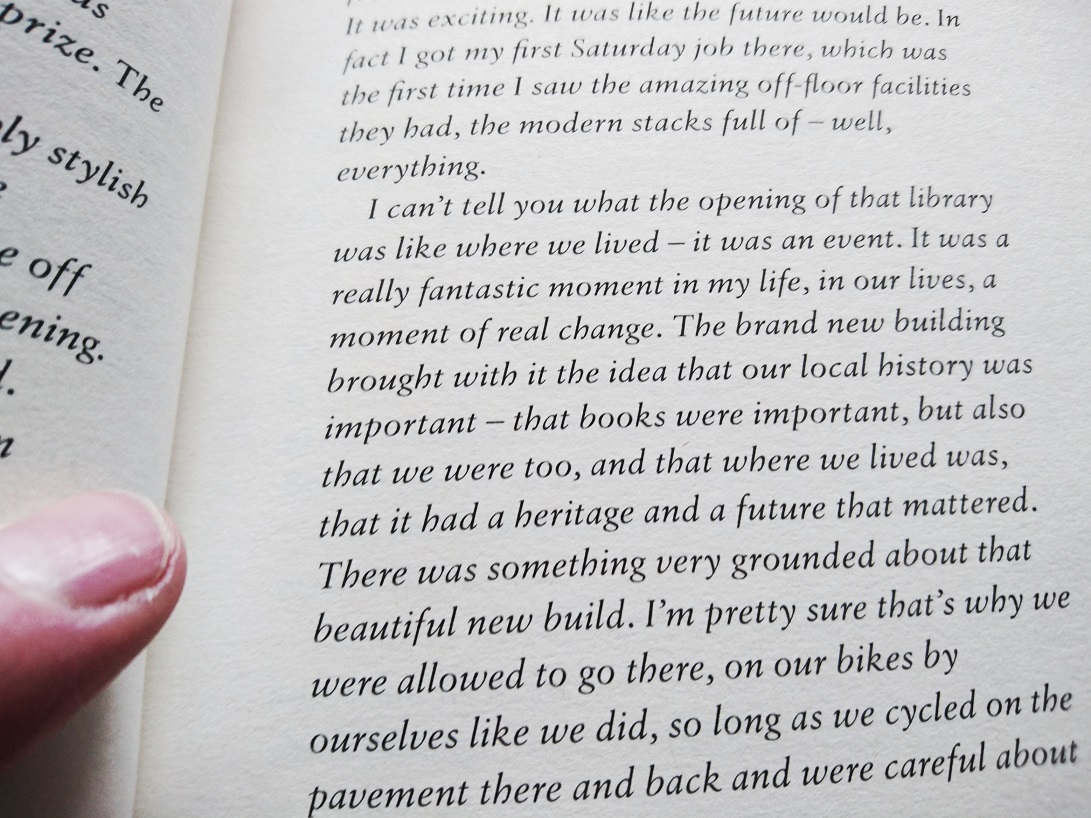
My local library in Ringmer is threatened with closure, despite having moved to a new building last year. It seemed an opportune time to borrow Ali Smith's 'Public library and other stories' and to quote her correspondence with Sarah Wood about the opening of a new library:
It was a really fantastic moment in my life, in our lives, a moment of real change. The brand new building brought with it the idea that our local history was important - that books were important, but also that we were too, and that where we lived was.


Monday, 1 May 2017

Finding your true voice for writing

Simon Armitage talks about the idea of a poet finding their true voice (from 'The Verb' 21st April 2017 on BBC Radio 3; this conversation started approximately 21 minutes into the programme). Ian McMillan asks "do you think you have to find a true voice?"
I think that's become a very convenient shorthand for blurb writers on the backs of books: "he has found his voice and he has found it early". In fact, I think it might have said that on the back of one of my books... as if it were there waiting under a stone and you just had to have a good rummage around the garden and you would come across this thing called 'your voice'. Because I think probably more realistically what happens is that when you start writing, you are experimenting, you're shopping around, you are writing portfolio collections, and what you notice eventually is that one version of your voice seems to be appreciated over others - and that's probably the voice that you start using in your poetry because you can see that it's an appealing one.

Thursday, 27 April 2017

So?

Iain Sinclair, talking about conversational sentences that begin with 'so':
"...it’s a signifier, a warning bleep letting the recipient know that nothing that follows has any billable consequence."

Friday, 3 February 2017

The shame that attaches

"I recall the times in fall 2011, during the occupation of Philadelphia’s City Hall, when I’d do something frivolous, like browse in a bookstore, and be overcome by the shame that attaches to any private activity undertaken in a moment of public upheaval."
Nikil Savil, writing in n+1 magazine, issue 26