Thursday, 15 November 2018

How Lewes bonfire was transformed by the Pope

In September 1850, Pope Pius IX appointed an Archbishop of Westminster and twelve other bishops. This recreated a structure for the Roman Catholic church that hadn’t existed in England for almost three hundred years.

The announcement was seen as hostile by many people around the country. Anthony Wohl, former Professor of History at Vassar College, notes that “several Catholic churches had their windows broken, and ‘No Popery’ processions were held throughout England”.

Lewes Bonfire 2013Effigies of the Pope and Cardinal Wiseman (the new Catholic Archbishop) were burned in Lewes outside the White Hart. In an opinion piece about bonfire celebrations, The Sussex Advertiser of 12th November 1850 (quoted by Brian Pugh in Bonfire Night in Lewes) said “since Dr Wiseman’s insolent usurpation the celebration of this anniversary has partaken to a much greater extent than formerly of an anti-Romanist character; and the substitution of the Cardinal for the almost forgotten Guy Fawkes seems inevitable.”

It’s around this time that ‘bonfire bishops’ started to make an appearance, writes Brigid Chapman, in Night of the Fires. “Soon they were preaching patriotism as well as Protestantism, and getting lots of column inches in their local newspapers as a result.”

Jeremy Goring, in Burn Holy Fire, points out that a Sussex Express article about the 1850 Lewes bonfire celebrations mentions a memorial tar barrel “ignited in sight of the spot where the papists were wont to light the faggot and burn to death their unyielding Protestant brethren”. He says this is the first time the paper had mentioned the martyrs of 1555 in connection with the town’s annual bonfire night.

However, he questions the timing of this interest in the Sussex martyrs. “Contrary to what the Sussex Express reporter maintained”, writes Jeremy Goring, “the strength of anti-Romanist feeling in Lewes probably had less to do with the past cruelties of Catholics than with the present activities of Anglicans.” He goes on to say “It is significant that the protests against the restoration of the Catholic hierarchy, culminating in a great bonfire in Lewes High Street, first took place at the very time when Frederick Teed, rector of nearby St Michael’s, was introducing what many regarded as reprehensibly ‘popish’ practices.”

This hostility towards Anglicans demonstrating any affection for 'high church' or Roman Catholic rituals was particularly obvious in the 1857 'Lewes Riots', which centred on the funeral of Emily Scobell. Emily was the daughter of the Rev John Scobell, rector of All Saints and Southover churches. Although her father's views were evangelical, she'd left home to join an organisation at the opposite end of the ecclesiastical spectrum: the Society of St Margaret, a Sussex-based religious group that worked to nurse the sick. This group had been set up by John Mason Neale, an Anglican clergyman who was often seen as pro-Catholic. Miss Scobell, who died after catching scarlet fever from a patient, had wanted to be buried alongside her mother at All Saints church. Her body was brought to Lewes by the Rev Neale and a group of eight sisters of the Society of St Margaret, who were met at Lewes railway station by a crowd shouting 'No Popery', according to Brian Pugh in Bonfire Night in Lewes.

After the funeral service, the congregation moved outside the church to the family vault in which Emily and her mother were buried. At this point the crowd became increasingly angry. "The nuns' habits were torn and Neale lost his cassock", notes Lewes History Group. The Rev Scobell described events from his perspective to The Times: "I was myself knocked down, and for a moment, while under the feet of the mob, game myself up for lost". Fortunately all nine left Lewes safely that evening, but not before half the group had been besieged in the King's Head pub for almost an hour.

Perhaps unsurprisingly, an effigy of John Mason Neale was paraded through Lewes during the following year's Bonfire processions.

Wednesday, 7 November 2018

TRE Talk Radio Europe 'gadget guru' tech for November 2018

Here's the technology I talked about in my November 2018 TRE Talk Radio Europe 'gadget guru' conversation:

Palm smartphone

Remember Palm organisers? Well, the Palm name is back – and this time it’s on a tiny smartphone that saves you from taking your regular smartphone out of your pocket or bag. It weighs 62½ grams, it’s 50mm wide by 97mm tall and it’s 7.4mm thick. On the front is a 3.3-inch touchscreen and inside is a Qualcomm Snapdragon processor running the Android operating system. The front and back are made from Gorilla Glass 3 and the phone is rated for IP68 water and dust protection. It even finds room for a 12 megapixel camera on the back and an 8 megapixel camera on the front.

What’s the point? Well, I suppose it’s a bit like having a smartwatch on your wrist – except this is potentially smarter but not quite so convenient. This 'companion phone' connects to your regular mobile number, so you can leave your big expensive phone at home and just take the little one.

There are two bits of bad news for Palm fans. Firstly, there’s not really any connection with the old company except the name. And the new Palm phone is currently only available from the Verizon network in the United States. So even if you spend $349.99 to get hold of one, you’ll need another phone on a Verizon contract to make it work.

Facebook Portal video screen

Facebook Portal is a smart display screen that offers hands-free video calling. There’s a choice of two devices: one has a 10.1-inch screen and one has a 15.6-inch screen (the bigger one is called the Portal+; it’s better quality and can also be adjusted more, but other than that they’re pretty similar). Both have Amazon's Alexa voice-controlled personal assistant service built in. They also have Facebook Messenger and a 12-megapixel camera, which means you can chat via video, with facial recognition enabling it to automatically zoom in on your face as you move about. So if your friends have got Facebook Messenger on their smartphone or their tablet, you can ask your Facebook Portal to call them. And because it runs on Amazon Alexa, you can also ask for sports results, weather forecasts, listen to music, do your shopping or control smart home devices. It can even be a picture frame when you’re not using it.

At the moment both devices are only available for pre-order in the United States, with the regular Portal costing $199.

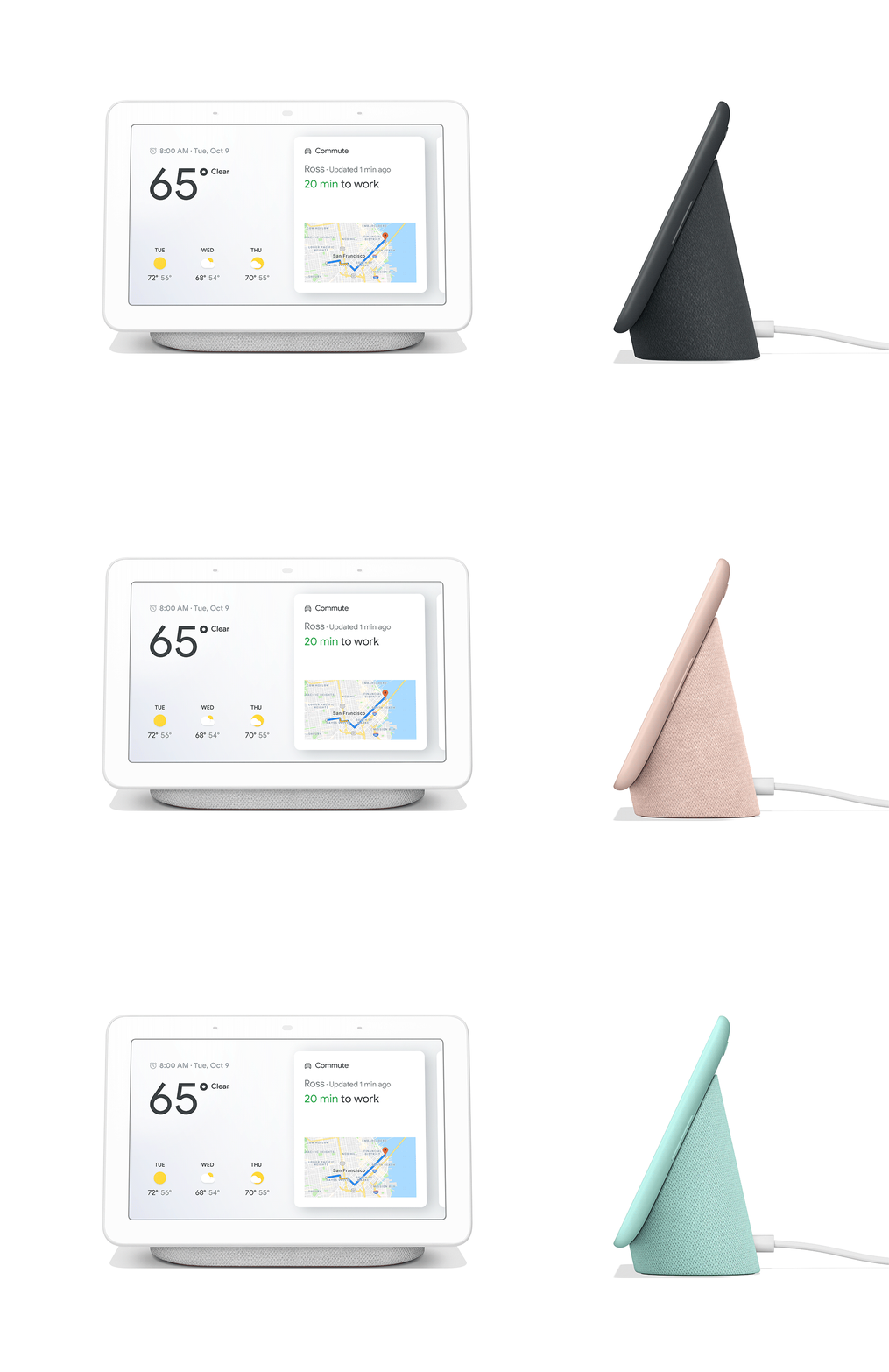
Google Home Hub

Facebook has its Portal, Amazon has its Echo Show, now Google has its Home Hub. This is another voice and touch controlled information centre for your house. However, unlike the Portal, there’s no camera – so you might feel happier about having it in the bedroom.

Google already has voice-controlled assistants but this adds a 7-inch screen, so you can ask it for maps, for videos, for photos, for music, for recipes, you can look at your calendar, and so on. Plus it’ll connect with compatible smart home devices to dim your lights, adjust the thermostat or watch security cameras.

Google’s Home Hub is currently only available in the UK (£139), the USA and Australia.

iBubble underwater drone

This is described as “the world’s first intelligent autonomous and fully wireless underwater drone”. It’s from a French company called Notilo Plus, which specialises in underwater exploration, and essentially it’s a remote-control submarine that can drive itself.

You fit your camera inside, strap on your special wristband and the iBubble will follow you underwater for up to an hour and down to 60 metres - almost 200 feet - without bumping into things. You can tell it to follow you, to go ahead of you, to film from the side, to circle around you, to come to you or to stay still. It can also be connected to an optional cable and directly controlled from the surface using an app on your phone or tablet.

The retail price of the iBubble is $4,099 (around €3,600), excluding VAT and the cost of a camera. It’s designed to work with newer models of GoPro and other action cameras that use the same type of mount.

Monday, 29 October 2018

Rocket FM Lewes: 'Talking Culture' 29th October 2018

The music on my Rocket FM Lewes 'Talking Culture' show this afternoon included:

Pentatonix: Can't Sleep Love
Harriet: Afterglow
Rufus Wainwright: Across The Universe
Johnny Cash: Hurt
Mary Gauthier: I Drink
Ward Thomas: Guilty Flowers
Show of Hands: Walk With Me
Ellie Goulding: How Long Will I Love You
Justin Hayward: The Best Is Yet To Come
Norrie Paramor and the BBC Midland Radio Orchestra: Thank You For The Music

Sunday, 28 October 2018

Be a person instead of a source of fragments

In his blog post You don’t have to live in public, Austin Kleon points us towards Jaron Lanier's book You Are Not A Gadget. He quotes Jaron's list of things "you can do to be a person instead of a source of fragments to be exploited by others", which are often counter-intuitive for the online services we use. Spend time crafting our work, don't force it into social media templates, express yourself...

However, it's Jaron's introductory phrase - be a person instead of a source of fragments to be exploited by others - that particularly resonates with me. Perhaps it's because I hear parallels with "if you're not paying for the service, you're the product, not the customer". But probably because I don't do it enough.

Monday, 22 October 2018

Rocket FM Lewes: 'Talking Culture' 22nd October 2018

The music on today's Rocket FM Lewes 'Talking Culture' show included:

Beth Nielsen Chapman: Almost Home
Jamie Cullum: I Could Have Danced All Night
Julie Andrews: Just You Wait
Frank Sinatra: Get Me To The Church On Time
Beyonce: Love On Top
BBC Midland Radio Orchestra: Go West
Garth Hewitt: Oscar Romero
Was (Not Was): Walk The Dinosaur
Amy Winehouse: Tears Dry On Their Own
Celine Dion: Here There And Everywhere
Feist: Mushaboom
Britney Spears: Everytime
Barbra Streisand: Taking A Chance On Love

Monday, 15 October 2018

Rocket FM Lewes: 'Talking Culture' 15th October 2018

I'm presenting 'Talking Culture' on Rocket FM Lewes for the next three weeks. My guests in this week's show were:
Simone Riley, the current chair of Chalk Gallery,
Lulah Ellender, who wrote Elizabeth's Lists,
Vivienne Lynn, whose art is currently on show at Martyrs Gallery.

Today's music included...
Simon and Garfunkel: Keep The Customer Satisfied
The Partridge Family: I Think I Love You
Nickel Creek: Ode to a Butterfly
Norrie Paramour and the BBC Midland Radio Orchestra: Copacabana
Eddi Reader: Patience of Angels
Marc Cohn: Walk Through The World
The Chefs: 24 Hours
Charlie Dore: Here Comes The Sun
Renaissance: Northern Lights
Bellowhead: Betsy Baker
Kathy Mattea: Where've You Been
Josh Groban: Granted

Tuesday, 25 September 2018

My TRE Talk Radio Europe technology for September 2018

Here's a summary of the tech I mentioned in this afternoon's 'gadget guru' chat on TRE Talk Radio Europe:

Apple Watch 4

This month Apple has announced three new iPhones - the iPhone XS, the iPhone XS Max and the iPhone XR - as well as a new Apple Watch. The smartwatch is particularly notable because it includes a couple of impressive features.

Probably the most significant update from previous models is that the Series 4 Apple Watch can act as an electrocardiogram (ECG). There are electrodes built into the front and there’s a heart rate sensor in the back. If you’re concerned about heart health, these readings could help you - and help your doctor, too.

The other major new feature is a fall detector: if you fall over, the watch can sense this and call for help.

There''s a choice of two sizes and various specifications: pricing starts from £399 / €429.

Vivosmart 4 fitness wristband

The new Garmin Vivosmart 4 is – as the name suggests – the fourth generation of this particular fitness-focussed smart wristband. What’s so special? It includes a pulse oximeter, which can keep track of your blood oxygen level. This helps with tracking your sleep; not just the amount but the quality as well.

It also includes a heart rate monitor that links with your stress level and your sleep quality to work out the best time for you to start a workout.

Pricing is around £120 (€135).

Segway Drift W1 electronic skates

Remember the Segway, which was an incredibly clever two-wheeled platform that you could stand on and ride? There was just one problem: in the UK (and an assortment of other countries) you couldn’t ride it on the road – and you couldn’t ride it on the pavement either.

Since the launch of the Segway PT in 2001, the company has changed ownership a couple of times – but it's not gone away.

And so we're introduced to the Segway Drift W1. These, according to the company, are self-balancing e-Skates. In reality, they have the appearance of a motorised roller skate crossed with platform shoes. Pricing is £359 (just over €400), with delivery expected next month.

When you stand on the skates, you'll find they balance themselves, so all you need to do is lean forwards to go and lean sideways to steer. Your maximum speed is 7½ mph (12km/h), which is two or three times faster than walking, and your rechargeable batteries will keep you moving for up to 45 minutes.


Just one bit of bad news. Unfortunately, it’s not just the technology that’s similar to the original – it’s also the legal situation. Here in the UK, usage is restricted to private property – with the owner’s permission, of course.

Locky smart key

Gnerally speaking, smart locks have one big disadvantage: you need to change the lock in your door. But what if you could keep your lock and turn your key into a smart key? That’s exactly what this particular Kickstarter project is all about.

Locky is a little device that clips onto your key, like a fancy key cover. Inside that fancy cover is a tiny battery that lasts for around a year, some clever sensors and a Bluetooth connection.

Basically, the sensors work out if you’ve turned your key in the lock. The Bluetooth connection then links with an application on your phone to warn you if you’ve left home without locking the house. It’s also capable of warning you if you’ve left your key behind and can even help you find the key if you put it down somewhere. Plus it keeps a record of key use, so if all your family have a Locky on their key, you know if someone’s in and when they returned.

Most importantly, it’s still a mechanical key. It can’t be hacked and it unlocks your door even if the battery goes flat.

The company reckons they’ll start shipping these in March next year for around £60 each but there are currently special offers if you commit early.